Written by Paul J Bucknell on October, 18, 2025
Isaiah 3-4 Understanding Devastation: Answers the meaning of seven women seeking one man in Isaiah 4:1.
The Question
According to Isaiah chapter 4, a time will come when seven women will be bound to one man. Is this prophecy about multiple marriages or something else? Could you please help me understand this scripture?
An Explanation of Isaiah 4:1
Let’s start by reading Isaiah 4:1, the verse in question.
“For seven women will take hold of one man on that day, saying, ‘We will eat our own bread and wear our own clothes, only let us be called by your name; take away our disgrace!’” (Isaiah 4:1).
There is a good reason for confusion about Isaiah 4:1. The answer lies in its placement in modern Bibles, with added chapter and verse markers. In the 1200s, Langton introduced chapter markers for the Vulgate translation. These chapter and verse markers are not divinely inspired and contain numerous errors, such as in Isaiah 4:1.
The end of Isaiah 3 should be chapter 4:1, not 3:26. Verse 1 provides a detailed description of judgment from chapter 3.
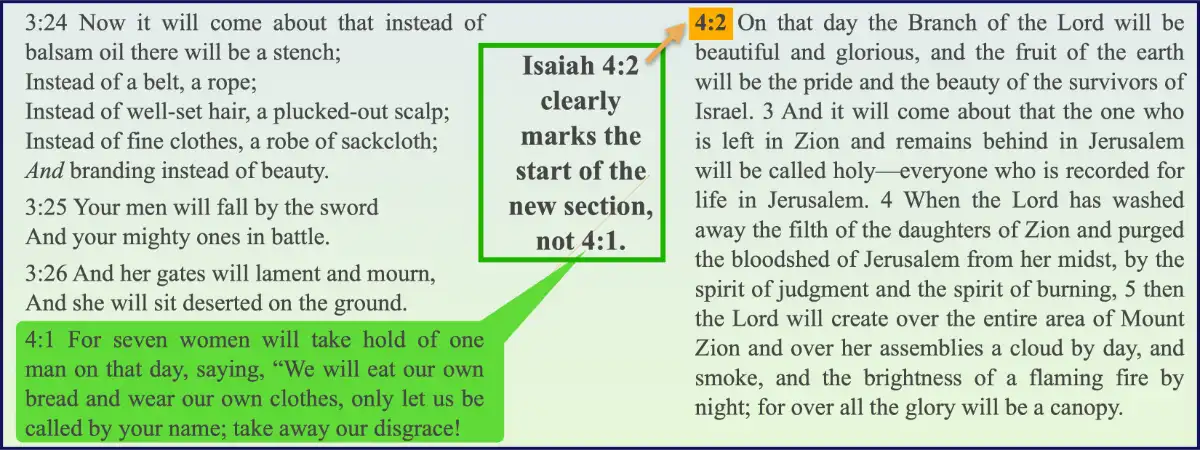
In Isaiah 4:1, we can imagine many men enduring war or famine. The remaining women are struggling to survive. It is not a prophecy of something to look forward to but a sign of utter devastation because Israel has forsaken the Lord. Let me reaffirm the context by describing these two aspects.
(1) God Forsakes Israel (Isaiah 3:1)
3:1 For behold, the Lord God of armies is going to remove from Jerusalem and Judah both supply and support, the entire supply of bread and the entire supply of water;
God Himself will oversee the judgment of His people, Jerusalem and Judah (the southern kingdom). The country’s infrastructure (supply and support) will be severely disrupted, and the people will suffer greatly, leading to the following signs.
(2) Signs of a God-Forsaken Land (Isaiah 3)
Isaiah 3 is full of strong signs of judgment that God promises to His people who have forsaken Him. Isaiah chapter 4:1 continues this theme and clearly belongs to chapter 3 in this regard.
3:25 Your men will fall by the sword
And your mighty ones in battle.
3:26 And her gates will lament and mourn,
And she will sit deserted on the ground.
4:1 For seven women will take hold of one man on that day, saying, “We will eat our own bread and wear our own clothes, only let us be called by your name; take away our disgrace!
Isaiah 4:1 is not a scene to look forward to. God is not promising good here but predicting the worst kind of destruction. “On that day the Lord will take away the beauty of their anklets, headbands, crescent ornaments” (Is 3:18). Read all of chapter 3 for a clearer sense of the devastation that will come upon Israel.
It would have been better to include Isaiah 4:1 with the desolations of chapter 3 and to start chapter 4 with what is verse 2, which introduces the promise of the coming Branch of Yahweh—a promise of the Messiah, who is indeed Jesus Christ (cf. Is 11:1). Alternatively, chapters 3 and 4 could be combined, instead of visually separating 4:1 from its chapter 3 context.
Chapter 4:2-6 is not a series of separate prophecies closely linked to the Messiah, but rather a vivid description of God’s judgments and blessings that the survivors of Israel will face much later. We offer an overview of the first six chapters below.
An Overview of Isaiah chapters 1-6
1) God’s Willingness To Help His People (Isaiah 1-6)
Amid Yahweh’s thunderous threats, He clearly offers His people a chance to respond to His gentle and kind invitation to return to Him. Isaiah’s humble reply in chapter 6 reflects the positive response that God desires.
Ch. 1: Religious bankruptcy - religious behavior does not cover up the heart’s wickedness.
Ch 2- 4:1 Prophetic ruin - the prediction of Israel’s ruin is only interrupted with brief calls for repentance.
Ch 4:2-6: A promise of the general blessings of the coming Branch of the Lord (i.e., the Messiah).
Ch 5: Immoral society - Isaiah continues to identify God’s expectations and Israel’s failures, highlighting societal sins and distorted values (5:20-21).
Ch 6: Confirmation of God’s Word - Isaiah’s prophetic call is another example of God’s call to Israel and willingness to work patiently with them.
Background of Isaiah 1-6
King Uzziah’s (also known as Azariah in 2 Kings 15:1, 32) prosperity led to political pride and religious forgetfulness. Their political, media, and business boastfulness mirrors modern society, which relies on the wealth, disciplined thinking, and practices of previous hardworking generations. Once again, the society has foolishly forgotten its foundational roots.

Study Questions for Isaiah 3-4
1. Why is Isaiah 4:1 better understood as part of chapter 3 rather than a separate prophecy?
2. What social and moral conditions led to the devastation described in Isaiah 3–4?
3. How does the image of “seven women taking hold of one man” reflect judgment rather than blessing?
4. In what ways does Isaiah 4:2–6 bring hope after judgment?
5. What parallels can you see between ancient Israel’s downfall and modern society’s moral decline?
6. How does the prophecy of the Branch of the Lord point to Jesus Christ’s redemptive work?
Hashtags
#IsaiahStudy #BiblicalProphecy #Repentance #Faith #JudgmentAndMercy #SpiritualRestoration