
Written by Paul J Bucknell on April, 15, 2026
Genesis 28:10-22 Surprising Encounter with God
A person’s greatest good always starts with meeting God. Most people today do not think this way; neither did Jacob. But as we look at his life, we find that a meeting with God is not only needed but also the best thing for his life and those around him. Let’s explore three aspects of these encounters with God by looking at Jacob’s meeting with God in his dream.
- A) Needing God (Genesis 28:10-12)
He was going astray and was full of fear. He needed to be brought back.
- B) Knowing God (Genesis 28:13-15)
Many want direction for their lives, but this only comes after they know God.
- C) Responding to God (Genesis 28:16-22)
Hearing from God is common but the difference is that we let Him change us.
An Unexpected Encounter
Genesis 28 stands as another one of those powerful links in the holy scriptures that define how God unexpectedly and uniquely works in the lives of unworthy individuals. Jacob did not expect or search for this God-encounter. Nor were his parents, Isaac and Rebekah, thinking about spiritual matters. This story forms at a time when everyone was at a spiritual low. A fierce storm was brewing at home, and God was not much on their minds.
A) The Need for an Encounter with God (Genesis 28:10-12)
Genesis 28:10-12
“10 Then Jacob departed from Beersheba and went toward Haran. 11 And he came to a certain place and spent the night there, because the sun had set; and he took one of the stones of the place and put it under his head, and lay down in that place. 12 And he had a dream, and behold, a ladder was set on the earth with its top reaching to heaven; and behold, the angels of God were ascending and descending on it.”
Our Need for an Encounter
Jacob’s encounter with God must be viewed within its broader context; otherwise, a key part of the message can be missed. While this is a powerful and meaningful encounter, Jacob was not one of those spiritual men actively seeking God. Nor did he do anything especially good to earn God’s promised blessings. In fact, the opposite is true, and Jacob probably better represents our lives—those caught in the materialistic pull of the world. Depending on one’s background and upbringing, many might agree that Jacob deserved something bad to happen to him. That was his karma–his lot in life. After all, he went along with his mother’s plan to deceive his father and steal the blessing. Now, his father was upset with him, and his brother Esau was out to kill him.
True, Jacob was not as bad as Moses, who killed someone and ran away, but in God's eyes, deceiving one’s father and stealing from a loved one exposes a significant flaw in his moral character. Even Esau could see through Jacob’s selfish and evil nature.
God’s repeated involvement in human affairs is a key lesson from the Book of Genesis. As with Adam, Eve, Noah, Abraham, and Jacob, without God's intervention, we tend to remain in doubt. This remains true today.
Understanding our unbelief
Unbelief appears in various forms. We might come from a country or home with beliefs quite different from the Biblical worldview. Our minds could be convinced that our modern beliefs are correct. Or perhaps, we might be indifferent to such issues concerning the spiritual world. Some may even hold an atheistic perspective, denying God’s existence. However, they all share the common issue of unbelief.
Did Jacob have a biblical perspective of God? One might conclude he did because his grandfather and father were strong monotheists. They firmly believed that this one God, the LORD, was the maker of the heaven and earth. Evidence of this household faith can be seen in the approach of Abraham’s servant in the way he sought after a wife for his master Abraham’s son. Abraham said, “I will make you swear by the LORD, the God of heaven and the God of earth, that you shall not take a wife ...: (Genesis 24:3). Then we see this servant pray to God, “And he said, “O LORD, the God of my master Abraham, please grant me success today...” (Genesis 24:12).
In one sense, Jacob and Esau both believed, yet their life choices show that each experienced some unbelief. Whatever their ideas about the Lord God were, He did not strongly influence their decisions and lives. They acted independently and showed no fear of God. For example, Esau took wives that displeased Isaac (Genesis 28:8-9), and Jacob was cunning and deceitful. Both approached life as if God did not really exist.
It is vital that we understand our own faith correctly. Many people call themselves Christians but are truly unaffected at the core of their hearts by God’s presence. They might say they believe and may have even been baptized, but God does not direct their lives. They resemble Esau and Jacob, carving out their own paths in this world. These individuals may identify as Christians, but their way of living proves they don’t truly know God. They might know about God intellectually, but without a direct personal encounter with Him, their lives largely mirror those of religious unbelievers.
These religious people, regardless of their faith, believe they deserve God’s best. In Jacob’s case, his mother thought that a special word at his birth made Jacob more worthy of that spiritual inheritance (Genesis 25:22-23). Isn’t it interesting how people ignore their flaws while they boast about how God should favor them? They deserve exactly the opposite of what they hope for. Insight into this corrupt, self-centered heart is part of the grace God gives to those He reveals Himself to.
Undeserving and unworthy
The main lesson from this incident is that Jacob did not deserve God’s favor at all. He was not setting out on a spiritual journey from Beersheba. Instead, he was fleeing for his life, much as Moses did. Don't our lives share some similarities with Jacob’s?
Our circumstances may differ greatly, but God is clearly showing us how radical His work is! Just compare Jacob’s name, which means twisted, with his new name (mentioned later in Genesis), Israel. Religion does not save, not even biblical religion. Religion tends to deceive more than save because it is rooted in pride. In the world’s eyes, we might appear to be on a path to success, but spiritually, our journey is filled with ruinous choices.
God touched me
Only an encounter with the Lord can help us see clearly. I remember when God saved me. I was quite content with my young pursuit of life. I disdained the church, yet I was confident all was well with my soul. But God shattered that illusion when, at a meeting, He spoke to my heart through a vision. All that I had secretly rejoiced in became the very thing God used to reveal the evil in my heart and my need for His salvation.
The ladder from heaven to earth reveals God’s interest in humanity. He is involved in earthly affairs not just to serve justice but to extend acts of mercy and grace to unworthy sinners. This experience is unique for Jacob. None of us should attempt sleeping on a rock in the middle of nowhere, thinking God might speak to us in a dream. However, it is good to desire to meet God, as it shows we are spiritually alert. Without experiencing God, we will go through life until our breath runs out. We desperately need God to halt us in our vain pursuits.
Otherwise, like Esau, we will find that our end has come and that what we gained on earth is lost—first through old age, then death. We cannot take these things with us. We might covet titles, wealth, deeds, and more, but age and death surpass them all. Many aging people live in the most beautiful places but cannot go out to enjoy them! Something greater exists, and this is the One we must seek.
The Pursuer
Jacob pursued the most valuable items. This was the positive side of him, though his willingness to use improper means to obtain those things revealed his darker side. More importantly, though, is that God, the Giver of all blessings, showed that something much greater existed beyond those material things he chased. God was extending a welcome mat, showing Jacob that there was a greater blessing in knowing the person of God. The ladder represented communication between heaven and earth, and the angels symbolized the good things God was bringing down to the earth. That intrigued Jacob, and he thought, if this is real and God can make it happen in his life, then he would pursue it.
Summary
We all can experience a moment of disbelief in the great almighty God. We might sense His existence or even grow up in a home that teaches about God from the Bible, but we do not become spiritually alive until we have a special, unique encounter with God.
“There is none who understand, there is none who seeks for God; All have turned aside, together they have become useless; There is none who does good, there is not even one” (Romans 3:11-12).
Application
Have you discovered that God is a greater good than anything you might find on earth? We might be religious, but we don't really believe it. After all, we hear so much about God not really even existing. But God does exist, and everything you gain on Earth is nothing compared to the abundant riches found in Jesus Christ. If you don’t really believe it, acknowledge this. But in the same breath, cry out, “God help me believe what is true, best, and awesome.”
B) Knowing God (Genesis 28:13-15)
- Many want direction for their lives, but this only comes after they know God.
“13 And behold, the LORD stood above it and said, “I am the LORD, the God of your father Abraham and the God of Isaac; the land on which you lie, I will give it to you and to your descendants. 14 “Your descendants shall also be like the dust of the earth, and you shall spread out to the west and to the east and to the north and to the south; and in you and in your descendants shall all the families of the earth be blessed. 15 “And behold, I am with you, and will keep you wherever you go, and will bring you back to this land; for I will not leave you until I have done what I have promised you.”” (Gen 28:13-15).
This powerful image seen in Jacob’s dream convinces us that God’s favor is upon Jacob. Notice how this set of promises is not conditional. It is blended with what was stated to Abraham and Isaac earlier.
Identifies Himself (13a)
The Lord starts by graciously introducing who He was as “the LORD, the God of your father Abraham and the God of Isaac.” Jacob was very familiar with this introduction. After all, it was all about Abraham, his grandfather, and Isaac, his father, who just bid him to go far away to Paddan-aram.
Peter in Acts 3:13 echoes the past, saying, “The God of Abraham, Isaac, and Jacob, the God of our fathers, has glorified His servant Jesus, the one whom you delivered up....” Jacob’s new name was Israel, which became the name of the nation we still call Israel today. It is through Jesus that this global blessing entered the world. Even now, people from all nations praise God. As they worship Him, they are blessed.
This understanding of God was completely different from what Jacob had previously thought or believed. Up to this point, the Lord Yahweh was just a God that others mentioned. Now, he personally recognized God as the Lord spoke directly to him.
The title LORD (all in capitals) refers to God’s own name, Yahweh. With each new revelation, the LORD’s character and plan become clearer. His name (hwhy) is used 5194 times in the Old Testament. However, God’s nature is understood more through experience than through reading books. Jesus’ “I am” statements further reveal God’s glorious person through Jesus Christ.
Reveals His Plan (13b-15)
With great purposefulness, the Lord highlighted what He would be doing. He does not ask Jacob what he wants but instead reveals His plan:
- The Lord will give the land to Jacob and his descendants.
- Jacob’s descendants will be in great number.
- Jacob’s descendants will spread out in every direction.
- Through Jacob and his descendants, all the families on the earth will be blessed.
These are incredible promises. Jacob didn’t realize what he was pursuing when he received his brother Esau’s spiritual blessings. In John 1:31, we see that Jesus alluded to himself as being in the same circumstance as Jacob–extremely blessed.
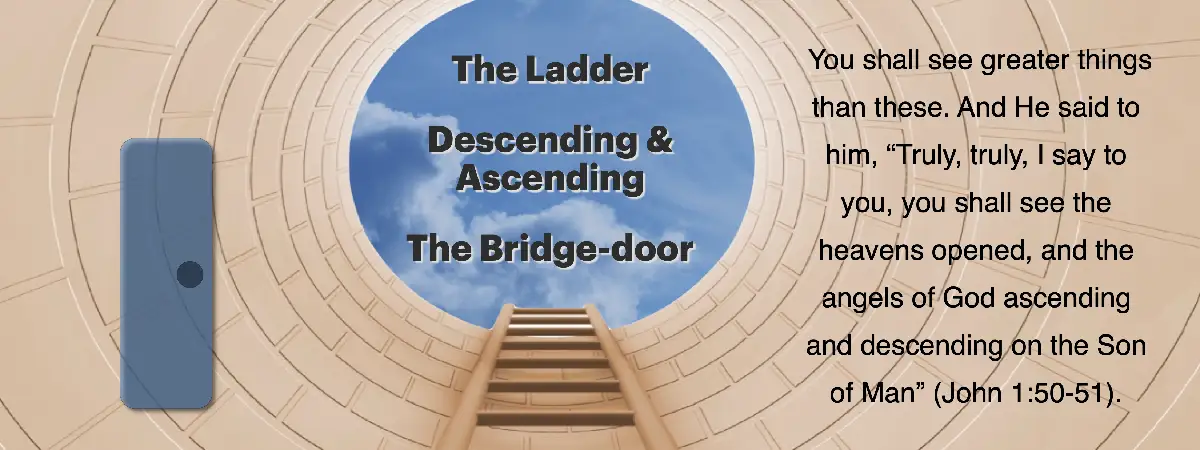
“Jesus answered and said to him, “Because I said to you that I saw you under the fig tree, do you believe? You shall see greater things than these. And He said to him, “Truly, truly, I say to you, you shall see the heavens opened, and the angels of God ascending and descending on the Son of Man” (John 1:50-51).
The contrast is striking. God pours out His promise of blessing to Jacob, a lie and cheat, who is fleeing to save his life after deceiving his father and brother. What will God do in Jesus’ case? Will He not bestow even greater blessings on Jesus Christ, the Son of Man, who faithfully carried out God’s work despite the pain ahead? Absolutely.
God’s blessings and Christians
Genesis’ message stays the same: God is good because He intrudes into our lives to free us from our stubborn unbelief. While secularism tries to keep God out of this cursed world, God regularly intervenes with His plans and promises, largely fulfilling them through Jesus Christ.
What about Christian believers? How do these promises relate to our lives? God in Christ will also wonderfully pour out His blessings upon us. Note Paul’s reflections here, “Christ redeemed us from the curse of the Law, having become a curse for us... in order that in Christ Jesus the blessing of Abraham might come to the Gentiles (non-Jews; literally ‘nations’), so that we might receive the promise of the Spirit through faith” (Gal. 3:13-14).
God desires us to receive His blessings. Just as He created a magnificent world, He wants to bless us with the best. As we believe in Jesus Christ, all of Christ’s blessings become ours as well. This is how believers can truly share in the blessings of God.
Reaffirms His Promise (15b)
God’s promise to Jacob is incredible. Our first big question is why God would make a promise to anyone, but especially why He would make such incredible promises to Jacob, who couldn’t do much to fulfill them. “And behold, I am with you, and will keep you wherever you go, and will bring you back to this land; for I will not leave you until I have done what I have promised you” (28:15).
This reminds us of Matthew 28:20, “And lo, I (Jesus) am with you always even to the ends of the earth.” God promises a runaway that He will be with him. Notice His words:
- I am with you.
- I will keep you wherever you go.
- I will bring you back to this land.
- I will not leave you until I have done what I have promised.
In the chapters ahead, we will learn how God accompanies Jacob, blessing him and his descendants greatly (as well as training him). The rest of the Bible, which includes all its books, shows how God accomplishes and distributes these great blessings. These redemptive promises are part of God's overall plan to bring salvation to humanity worldwide.
Applications
What blessings do we desire, and which ones does God want to bless us with? We might discover that we are not seeking His blessing because we believe it is not the best. Or, due to negative thoughts about God, we might focus on gaining blessings for ourselves rather than for others. Many of us need a deeper love for God and others.
C) Responding to God (Genesis 28:16-22)
- Hearing from God is common, but the difference is that we let Him change us.
“16 Then Jacob awoke from his sleep and said, “Surely the LORD is in this place, and I did not know it.” 17 And he was afraid and said, “How awesome is this place! This is none other than the house of God, and this is the gate of heaven. 18 So Jacob rose early in the morning, and took the stone that he had put under his head and set it up as a pillar, and poured oil on its top. 19 And he called the name of that place Bethel; however, previously the name of the city had been Luz. 20 Then Jacob made a vow, saying, “If God will be with me and will keep me on this journey that I take, and will give me food to eat and garments to wear, 21 and I return to my father’s house in safety, then the LORD will be my God. 22 “And this stone, which I have set up as a pillar, will be God’s house; and of all that Thou dost give me I will surely give a tenth to Thee” (Gen 28:16-22).
Detecting our Response
The Lord spends extra time in the scriptures here, allowing us to see Jacob’s response to what He said in the dream. This helps us better reflect on our own reactions to Him. To better understand Jacob’s response, let's go back to Genesis 4, where God specifically encountered Cain. Cain was extremely angry, and the Lord stepped into Cain’s life to warn him not to act on his anger. God was again trying to reach into Cain’s stubborn and unbelieving heart.
God reveals Himself to us far more than we often realize. Although encounters with Cain and Jacob were more dramatic, God usually uses our circumstances to help us see better ways. He employs warnings from others, our consciences, or even hardships to more clearly show us His will. God offers valuable guidance, but we often ignore His counsel. When Cain hardened his heart toward God’s words, his situation worsened and led to terrible consequences. The same happens in our lives. When we doubt the good intentions behind God’s helpful words—often felt through our quiet but convicting conscience—we become more stubborn. If we don’t exercise faith in God’s goodwill, we tend to keep doing things our way, which can lead to serious consequences.
Jacob’s Good Response
Jacob, however, responded positively. He cherished God’s Words. He allowed their surprise to shake up his life. He took what God had said and made it a meaningful step in his newly found faith to learn more about God. This was undoubtedly Jacob’s spiritual rebirth. Jesus was likely referring to these things when speaking to Nicodemus in John 3.
6 “That which is born of the flesh is flesh, and that which is born of the Spirit is spirit. 7 “Do not marvel that I said to you, ‘You must be born again.’ 8 “The wind blows where it wishes and you hear the sound of it, but do not know where it comes from and where it is going; so is everyone who is born of the Spirit.” 9 Nicodemus answered and said to Him, “How can these things be?” 10 Jesus answered and said to him, “Are you the teacher of Israel, and do not understand these things?” (John 3:6-10).
Something important happened in his life, and after reflecting on God’s greatness, Jacob built a stone marker by hand. This marker was quite different from the altars Abraham had set up when God appeared to him. Altars usually involve sacrifice, but Jacob chose to build a pillar instead to commemorate this significant time and place. Pillars are tall stone columns. They might not be very tall, but they stand out as manmade structures. The stone he used as a pillow has now become the most meaningful stone of the monument. After constructing it, he placed the stone he had used as a pillow during his dream at the top and poured oil on it to dedicate the entire memorial.
After this, he named the nearby city of Luz, meaning almond tree, as Bethel. Jacob did not stay in the city overnight. As a guest entering the unfamiliar city of Canaanites, he would face unknown dangers (cf. example of angels visiting Sodom in Genesis 19). Bethel means ‘house of God’ (i.e., El representing Elohim, the word for God). Jacob was thinking about greater things regarding this city. Even this name revealed Jacob’s new authority. The land belonged to him, and so he renamed the city. This incredible dream suddenly became a central part of his life, yet he held back from fully committing himself to God.
Jacob’s bargain (Genesis 28:20-21)
There are several aspects to this bargain. Jacob once again demonstrates his bargaining nature, even with God. He makes a vow but begins with four conditional ‘ifs.’ Let’s note the four conditions:
If God will be with me
If God will keep me on this journey that I take
If God will give me food to eat and garments to wear
If God makes it so I return to my father’s house in safety
At this moment, Jacob had nothing. He was probably running away with only a knapsack. If he had a camel, he would have had more bundles. But he was poor and had nothing to sacrifice. Maybe that's why he built a pillar instead of an altar.
Jacob’s part
Jacob made a pledge. If he returned safely and blessed, then he would properly worship and sacrifice to the Lord. Jacob did not ask for special treatment, only for safety and basic provisions. This shows how much he feared going far away. Jacob, in his part, would make God his God and transform that pillar of stones into a house of worship.
Then the LORD will be my God.
This stone... pillar, will be God’s house.
All that Thou dost give me I will surely give a tenth to Thee.
The last thing he mentioned was the tithe of what he had. Although he didn’t ask to become wealthy, this ten percent (tithe) will definitely be reflected in the tithe. The more he returns with, the more he will give.
Jacob’s request may seem quite materialistic, but this is precisely where God met him–in his material and spiritual poverty. The way God honors this request shows that His spiritual nature is not opposed to material things. God created us with real needs that can only be satisfied by the things He made. Yet, the Lord requires us to make Him our main focus, not His gifts. If we make a vow and receive God’s good gifts but ignore Him, that is a serious evil. Similarly, if we reject His offer, that is also wrong. However, Jacob responded in faith.
Application
More particular to our lives, what is it that we need? What does God want of us? Have we made a vow, “If God..., then I will....?” Have you been faithful in fulfilling your vows to Him? God rebuked King Hezekiah for finding healing but not properly responding back to his Healer (cf. Isaiah 38-39).
Conclusion
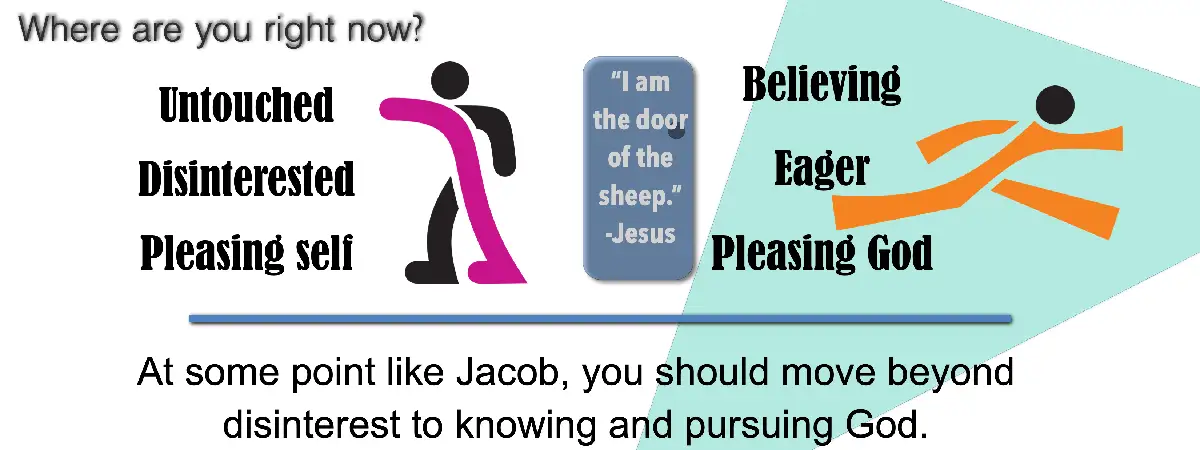
God interrupts our lives, whether boring or exciting, and uniquely places His words within us to significantly reshape how we think of Him so that we might pursue Him. It is helpful to recognize when our unbelief has shifted into belief, and doubts into faith. At some point, like Jacob, we should move beyond disinterest to truly knowing and pursuing God; otherwise, we risk ending up like Esau.
The Lord interrupted Jacob’s life by dropping the ladder right by his head. He has done the same by lifting up the cross high on Golgotha. Whereas the dream only spoke to Jacob and his descendants, but the Lord, through Christ’s work on the cross, has opened the door to all. Jesus stated, “I am the door of the sheep” (John 10:7). Like a ladder, window, bridge, or door, the Lord is breaking into each of our lives. You have heard the Gospel message, and the blessings are there for you and me.
How will you respond? I plead with you not to hide your unbelief, but to remember that God gives hope to those without belief. We start small when God, through some unique way, catches our heart’s affection and mind’s interest.