Written by Paul J Bucknell on July, 25, 2025
Matthew 9:35-38 Going into His Harvest | A Mission Message
Discover Jesus’ vision for evangelism and compassion in Matthew 9:35–38. Learn what it means to go, minister, pray, and reap the harvest in today’s world. A powerful challenge to join God’s work!
- - - - - - - - - - - - - - - - - - - - - - - -
What is one of your most troubling Bible verses? Mine comes from this passage. It’s not that I didn’t care about sharing Jesus with others. I did care. I told many people about Jesus. But what I experienced was so different from what Jesus says. Jesus said, “The harvest is plentiful." Now, that doesn’t mean I thought Jesus was wrong, but I kept this conflict in my mind for a long time. Maybe your experience is different. Perhaps many people are eagerly approaching you, wanting to hear the Gospel. I would share the Gospel with many people, but no one seemed very hungry.
When I was young, our youth group started a coffeehouse that God transformed into a Christian coffeehouse. Many people came, which was good. Most of them heard the Gospel, but they probably went for the music, the coffee, or the cool hangout spot of the Ship’s Lantern. Only a few truly came to know the Lord. I’m not saying that’s bad; it just seemed to confirm my observation that people didn’t really need Jesus. There wasn’t much of a harvest.
From a biblical standpoint, I knew people did need Jesus. Jesus was the Light of the World. I personally experienced a transformation through Him. Jesus was and is so special. As a result, I continued to spread the word. It was this passage in Matthew 9:37 that kept me going.
If it were up to me, I would have given up. Why bother? I feel awkward. It’s always hard to start a conversation with someone, and, again, not many people are genuinely interested. However, Jesus’ perspective challenged my experience, so I continued to share. Ultimately, I realized I had the wrong perspective. I couldn’t see things the way Jesus did. I didn’t fully understand how my Heavenly Father worked. Maybe this isn’t an issue for you, but when I began to understand this, it was like a breakthrough. Now I’m just starting to grasp this part of evangelism.
Let’s look at this passage together and see what Jesus does say. After all, Jesus accomplished more in three short years than all of us combined in our lifetimes. First, let’s take a closer look at this passage in Matthew 9:35-38.
“Jesus was going through all the cities and villages, teaching in their synagogues and proclaiming the gospel of the kingdom, and healing every kind of disease and every kind of sickness. Seeing the people, He felt compassion for them, because they were distressed and dispirited like sheep without a shepherd. Then He said to His disciples, “The harvest is plentiful, but the workers are few. “Therefore beseech the Lord of the harvest to send out workers into His harvest.” (Matthew 9:35-38; NASB used unless otherwise noted).
- Jesus’ Itinerary (Matthew 9:35)
- Jesus’ Insights (Matthew 9:36-37)
- Jesus’ Instruction (Matthew 9:38)
- Conclusions
A. Jesus’ Itinerary (Matthew 9:35)
If all the things Jesus did and said would fill the largest library on earth, imagine how brief a sentence would be that summarized all that He did. This is what we find in Matthew 9:35. Let’s read it once again.
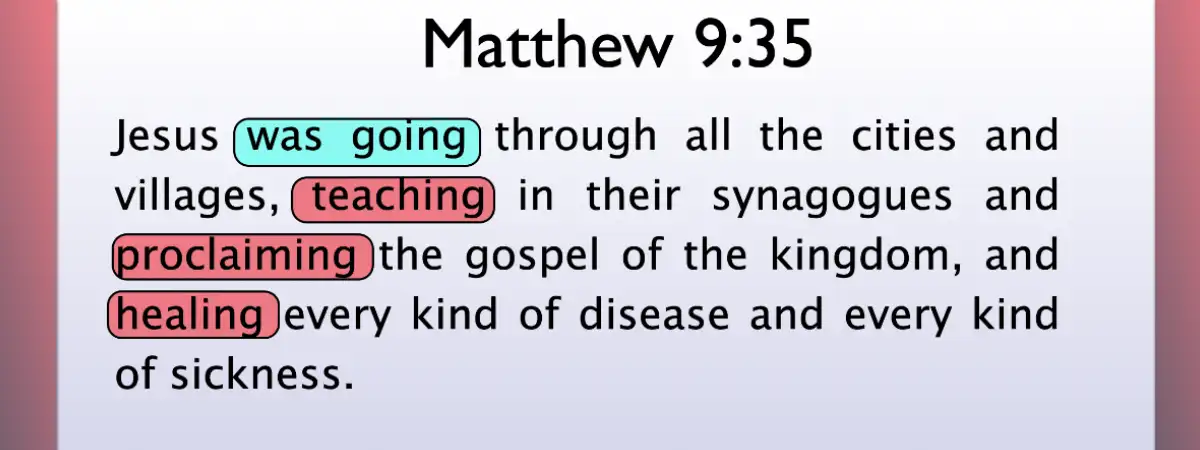
“Jesus was going through all the cities and villages, teaching in their synagogues and proclaiming the gospel of the kingdom, and healing every kind of disease and every kind of sickness” (Matthew 9:35).
1) Jesus was Going
The first thing that stands out is the word ‘going.’ Do you know what it reminded me of? It particularly reminded me of Matthew 28:19-20, the Great Commission. The two verses are similarly structured.
“Go therefore and make disciples of all the nations, baptizing them in the name of the Father and the Son and the Holy Spirit, teaching them to observe all that I commanded you; and lo, I am with you always, even to the end of the age.” Matthew 28:19-20
Do you see the word “go” and the ministry that followed? No matter what we think of the Great Commission, we can honestly say that Jesus did what He instructed us to do.
The best translation of this phrase is that Jesus was traveling throughout the land and continuing to do so. It’s something He did, and He still was doing it. The NIV doesn’t convey this meaning with the word ‘went.’ But it’s this movement outward into the world that is so characteristic of the Great Commission. “As you are going into the world, make disciples …” (Mat 28:18).
Behind all ministry is the push into new and sometimes uncomfortable places. For example, it would be much easier to sit down and play computer games or watch a movie than to reach out to others in need. As they ‘went out’, they found opportunities to serve others. By the way, the word ‘minister’ here refers to acts of Christian love through which Christ is made known in both life and words.
Others have made planned strategic ‘goings’ by going house to house visiting. They are open to God’s plan for them. Others still would take people grocery shopping or make a phone call to the new person. It is exciting to see how many ways the Lord leads His people.
The thrust of the Great Commission is not just to go but to make disciples. They and we are presumed to go. As Christians, we have the Spirit of Christ in us to accompany us wherever we go. It is dangerous to think of ourselves as stationary, still, and isolated. We do not always mean physical movement, because some circumstances, such as being a mom with little children, can be quite restrictive at times. However, within one's context, one needs to be open to others rather than closing one's heart.
Missions are based on the premise of ‘going.’ We have a responsibility to those around us. We must not stop with our own needs, our culture’s needs, our college’s needs, or our town’s needs, but like Jesus, be open to going where God leads. Our church has intentionally opened its doors to people from all nations. We still have much to learn, but God is a good teacher. I appreciate the addition of praying for the nations in our prayer meetings. Through these times, we can begin to sense how God wants us to reach out to our area or the world. We have gone, but we are still going, and I don’t think this will stop.
2) Jesus was Ministering
In Matthew 9:35, we see Jesus Christ engaging in various ministries. The word ministry means ‘to serve’ from the Latin ministerium. The focus of Jesus’ work, in other words, was on meeting the needs of others rather than His own needs. We don’t mean that caring for one's body is wrong. Not at all. But He dedicated His time and abilities to serving others as much as possible. He had an advantage, like some of you, in being single. We might not be called to such a lifestyle for life, but God does give us special opportunities to find more time to serve Him.
Singlehood is an opportunity to show great appreciation to the Lord by being filled with His Spirit and serving others in their time of need. When we focus on serving, our bad habits of wasting time can be easily set aside. Get involved in the lives of others, and you will see the change in yourself.
For example, I love chess. But when I got to university, I dropped out of the leagues to learn more about Christ and spend my time serving. Even now, it's rare that I get to play a game of chess, even though with a press of a button, I could have a good challenge. God might indeed have us ‘go’ by pressing on with some interest. I sensed that was the case when I was heavily involved in tournaments.
As captain of the high school chess team, I earned a lot of respect from others, which allowed me to live and speak out the gospel freely. The key is never to prize what we are doing so highly that we are unwilling to give it up if our Lord sends us elsewhere. Otherwise, we would be staying instead of going. Nor should we like what we are doing so much that we neglect our ministry. If there is no ministry, prayerfully participate for another month; if nothing comes of it, then consider it finished. Move on.
Let’s list the activities that Jesus was involved in.
- Teaching in their synagogues
- Proclaiming the gospel of the kingdom
- Healing every kind of disease and every kind of sickness.
‘Teaching’ seemed to be a more in-depth ministry of explaining God’s Word. He would do this in a protected location, such as a building. In this case, it was in synagogues, Jewish places of worship. People gathered together to learn more of God’s Word. We have many classes where we teach.
We can see how Jesus Himself ‘made disciples.’ He valued instruction. Instruction provides us with opportunities to continue growing. We offer discipleship classes, parenting classes, and a variety of instruction on how people can continue to grow. Of course, teaching also happens in our cell groups and families. I was appalled to recently hear that only 3 out of 10 evangelical parents consider evangelizing their children! If parents don’t value the gospel, then their children are likely to follow suit.
‘Proclaiming the gospel of the kingdom’ is an interesting phrase. First of all, we need to see that He was telling everyone about God’s kingdom. He didn’t just teach; He proclaimed it. Teaching is important, but it is very selective. We have a special discipleship class just starting. People need to come to it, though. If they aren’t here at 4 p.m., then they miss it.
However, the proclamation is more about engaging with people who wouldn't normally attend. Jesus went with the message. We see greater things happen when we start mingling with people we don't usually meet and share the good news about Jesus. We use whatever means are acceptable and effective.
But what did Jesus actually talk about? After all, Jesus hadn't yet died or risen. What gospel was there to share before He accomplished these things? We only need to look at the gospels to see what Jesus taught. He would expose lies with the truth of God. He proclaimed God’s kingdom to the Jews where they were. Since they had a Jewish background, He engaged them on their ground. His discussions would be quite different in content from ours. For the most part, they believed in the scriptures and the existence of God.
We, however, often encounter those who lack belief in God and reject absolute truth, favoring some form of secularism and materialism. When we share the gospel with these people, we must not only introduce the person and work of Christ but also highlight the glory and truth of the gospel. We need to show them that the kingdom of God is far greater than the bondage of evil. This becomes easier once we share our testimony of God’s kingdom power.
‘Healing every kind of disease and every kind of sickness’ is Jesus’ third powerful ministry. We often hear of healings through prayer, but we are severely unprepared to minister effectively in this area. For one, many are not even seeking God for healing; they rely on modern medicine. Even worse, many of us, God’s people, do not look to God as the healer ourselves. Instead, we rely on modern medicine. While God can use medicine—and does—medicine is much more limited than we tend to think.
I don’t have the gift of healing, but I am still trying to learn how God wants to distribute His gifts to His spiritual body, the church. I believe there are people with the gift of healing, but they don’t pray enough to realize it. Christ still heals, but we simply don’t feel enough. We don’t cry out to Him; instead, we prefer to be burdened with toxic drugs rather than humble ourselves before His throne. Can I ask why we have more confidence in sending people to a psychiatrist with his drug dispenser than to Jesus? It’s not only Christians who lose faith; many pastors do too.
We will see God's greatest power displayed through healing when we start praying for the needs of non-Christians. He can heal Christians, but Jesus was primarily out in the world ministering to people. Last week, we had Ding Fan visit. I remember she was near death, and her father had to carry her around. But through prayers from God’s people and some innovative medicine, God brought healing to her. Let’s ensure our ministry is not just words but action. May God’s anointing rest more powerfully on His people so that many others might come to the Lord. Our true anointing will be found not in medicine cabinets but on our knees before the Lord.
When I visited a few village churches in the mountains of India, they had long lines of people waiting for prayer. They wanted the preacher to pray for them. Can you imagine praying with over 100 people? As they came, their special needs were translated. Health was by far the greatest need—they had no medicine, no doctors, no recourse. Some issues could be quickly addressed if we shared our supplies and knowledge. Others required a miracle, like heart and cancer problems. I prayed for them, and I still wrestle with my inability to be a vessel through which Christ heals these people. But this is true around the world. Now, let’s see what Jesus had to say about these lost people.
B. Jesus’ Insights (Matthew 9:36-37)
Jesus had a special insight into people. I don’t mean that it is so unique that we cannot develop it ourselves. The point made here suggests that we should see things the same way. Let’s first examine Jesus’ understanding of their needs and then His Father’s view of them.
1) The Needs of the People (Matthew 9:36)
Jesus showed great compassion for the crowds because there were many people who needed help. But we also need to understand why He felt compassion.
“Seeing the people, He felt compassion for them, because they were distressed and dispirited like sheep without a shepherd” (Matthew 9:36-27).
First, He saw their distress and their inability to help themselves. They were like sheep without a shepherd. Of course, if one is a good shepherd, he will be very concerned with caring for the sheep without a shepherd. Unfortunately, I have never had a lamb to see what an ‘unshepherded’ lamb looks like. I expect it would be killed fairly quickly. However, I do know the difference between a pet cat and a stray cat, as well as a pet dog and a stray dog. One is lovely; the other smells and is tough. However, the sheep have an even worse problem.
They often find themselves in situations where they roll over and cannot get upright on their own. They are burdened with their wool. But before we get carried away with the imagery, let’s remember Jesus is speaking about people here.
What kind of people? Lost people. Suffering people. God knows that His judgment is about to come upon the world. Giant waves of judgment filled with war, deadly viruses, terrorism, and famine are already hitting the shores of mankind. They are unprotected. They can watch television and think everything is fine, but they do not realize that a wave is coming their way.
What makes this all the worse is that they cannot recognize their true dilemma. It is much like a tsunami. Animals seemed to sense the danger and fled, but people were oblivious. They were out boating, working, having tea, or walking along the coast. They could not see the danger coming.
I believe that people are most likely to recognize their danger when they see hope. When someone is in darkness, they know nothing but the darkness. An abused person thinks that is their life. An anxious person believes that is how they must live. A selfish or argumentative person thinks that’s just their nature. They don’t seek change unless their circumstances become unbearable and they see hope for something better. Do you have this compassion for the lost?
Two issues prevent us from having compassion. First, there is the self-centered perspective. We tend to see people not through their needs but through our own. People are our customers, waiters, colleagues, parents, strangers, interrupters, friends, and more. We don't take the time in our busy lives to truly see them as individuals. We can’t love them unless we do. Once we start thinking about their lives and needs, then we can begin to love them. Some couples never even reach this point.
Second, we don’t believe that people are as badly off as they seem to be. Do you genuinely believe they are perishing? Can you send money to the tsunami victims, but not help those in spiritual need around you? The scriptures clearly show that a person’s sin condemns them to a life of darkness.
Evil only offers hope when it can gain more control over a person. They are justly falling into the pit of eternal fire because of their sin and independent spirit, but we often stand at the bus stop without considering their need.
The story of Lazarus should speak to us.
But Abraham said, ‘Child, remember that during your life you received your good things, and likewise Lazarus bad things; but now he is being comforted here, and you are in agony. And besides all this, between us and you there is a great chasm fixed, in order that those who wish to come over from here to you may not be able, and that none may cross over from there to us.’ And he said, ‘Then I beg you, Father, that you send him to my father’s house--for I have five brothers--that he may warn them, lest they also come to this place of torment.’ (Luke 16:25-28).
Please remember Jesus’ compassion. He felt compassion because, despite the crowd, He took time to see their needs. He paid attention to those around Him and truly understood people as they were. He recognized how sin can profoundly affect others. People might try hard to pretend everything is fine, but inside, they are breaking apart, consumed by jealousy, anger, hatred, bitterness, worry, and plain old loneliness. Darkness has entered their souls. They need God’s light and forgiveness through Jesus. They need His hope and a relationship with God. Only in this way is there any real hope.
2. The Concern of the Father (Matthew 9:37)
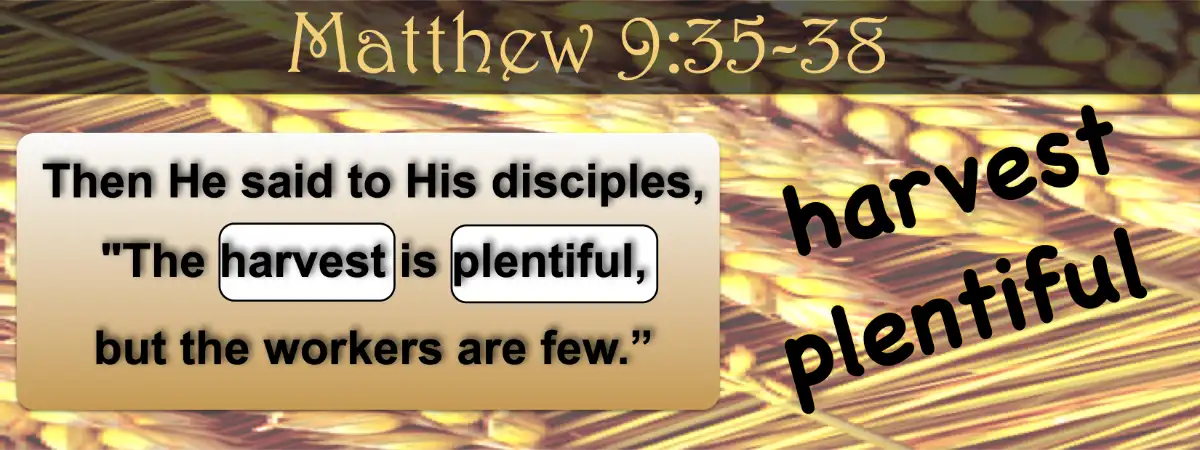
“Then He said to His disciples, 'The harvest is plentiful, but the workers are few” (Matthew 9:36-37).
This passage has troubled me for a long time. Jesus didn’t say that the crop would be large this year, but that the harvest was plentiful. This meant that people were already gathered by God’s grace, just like a full golden stalk of wheat hanging down at harvest time. I could agree that people were lost, but I couldn’t see the harvest. People didn’t seem ready for the Gospel.
Part of the problem was that I had lost sight of people’s real needs. My compassion was nearly gone. Another part of the problem was that I believed, to some extent, that people weren’t as bad as the scripture said. At least, that’s what I kept hearing from others. However, the biggest problem was that I simply didn’t understand how the Father worked. As I mentioned, I am still a beginner. What about you?
If there was a harvest out there, wouldn’t you do something about it? When my strawberries are lovely and red, will I let them sit there? I know if I wait one day after they’re ripe, they will be eaten by birds or disturbed by bugs. Every day, I notice the harvest and pick the ripe strawberries. When we believe there is a harvest, as Jesus says, we will look and live differently. We will shift our priorities.
A harvest shows that God can save many people whenever we take Him seriously. The problem is that we don’t always take Jesus’ words seriously. We assume only a few are ready to be gathered and spend more time in virtual worlds rather than with real people. Some may say they are not interested in the Gospel, which is natural because they are in the dark. The other concern of the Father was that there are few workers, which is closely connected to the first point about the urgency of the harvest. There's never been a time when it’s more important to have everyone busy in the harvest fields than during harvest time. Remember, the fields are always there, but the harvest is not.
Jesus’ point is that, like during harvest, more workers are always needed. The lesson for us is clear: if the harvest is plentiful—and it is, not just was or can be—then we must share the Father’s concern and help bring in the crop. I agree that evangelism should be a top priority in the church of God. While scripture doesn't specifically command us to prioritize choir programs, even though they are nice, it makes sense to join the Father in His work. This perspective helps us better understand how the Father works.
Only by sharing His concern can we truly join His work, and if we take Him seriously, He will guide us to the right fields. Prayer is vital to understanding how to work with Him, because after all, we are doing His work.

C. Jesus’ Instruction (Matthew 9:38)
“Therefore beseech the Lord of the harvest to send out workers into His harvest” (Matthew 9:38).
Our Involvement
We first must realize that we can make a difference. The evil one doesn’t want us to understand this. He will keep us distracted with doctrinal disputes while the lost perish. But once we are convinced that God will actually do more because of what we do, then we see how urgent it is to make His work a priority.
We need to pray. That is what Jesus clearly emphasizes here. Through our prayers, darkness is broken apart by God’s light and truth. Those who seem uninterested become engaged. My brothers and sisters, God is waiting for us to cry out for the lost. We are not just to pray—we need to pray out of compassion. We need to pray with tears. We need God to remove our mask of worldliness and help us see the urgency of the task.
I recall that when I first went to Taiwan as a missionary, I noticed something was amiss about the makeup of the missionary force. I started praying for men and families. Within 3-5 years, we observed that the missionaries had become much more normal and better prepared to do God’s work.
We need obedience. We can discuss people’s needs at length. We can even give money. But Jesus says we need to focus on prayer. Once we prioritize prayer, everything else in our lives begins to fall into place. But do you pray for the lost? Which missionary are you praying for? What continent or nation has the Lord placed on your heart?
How will we receive God’s anointing unless what moves God also moves us? Have you ever prayed as Jesus told you, “Therefore beseech the Lord of the harvest to send out workers into His harvest”? We might say it, but did we feel the urgency? Did we pray from our hearts to send out workers?
Our Going
We have many who are thankfully considering full-time service after leaving our church. They are somewhere along the path or preparing themselves. This is one of the great blessings of our church.
There are others, though, who are stuck dead in the middle of their careers and resolute in not going. But we need to pray and break their uncompassionate and self-indulgent lifestyles. If Jesus wants them to go, we need to pray that they will go. I am not only talking about sending them into full-time ministry but about being active right here, right now. Do you watch church happen? But you might say, “I am only a seeker.” Why are you a seeker? Jesus is here. Repent and go. None of us can afford to stay still. We all must move forward. We all must be moved to the deep heart of prayer, where we regularly pray for the lost and pray for all of us to go.
Only God can move them, but clearly, we need to pray to the Lord of the Harvest to get them moving. Do you believe that the Father will send workers even if we don’t pray? If so, then why did He tell us to pray? If evangelism is our concern, then we must urgently plead with God that He send forth His workers.
Prayer: Dear Father in Heaven, forgive us for not having a heart like Yours. Because we don’t think like You, we don’t see all the great things You are doing or want to do. Forgive me for not making these things a priority in our lives.
But now, Lord, lest I ask for grace and not change, I want to ask You to send out workers into the harvest. Please, Lord, the harvest is real. Now is the time to send workers into it. Lord, open the hearts of Your people. Prepare your people. Send Your people into the harvest. Please, Lord, do not delay. Hear my prayer in Jesus’ Name, Amen.
Summary
1. Going: fostering new contacts
2. Ministering: serving others
3. Compassionate: see needs of others
4. Praying: asking God to send workers.
Did you notice that Jesus said that the harvest is “His harvest”? He has everything arranged. He is waiting for us to call upon Him. Are we calling? With compassion? Regularly? Urgently? The harvest is plentiful. May God raise up great harvesters from here for His kingdom! Waves of judgment threaten the crop. We need to act now.