Written by Paul J Bucknell on July, 02, 2025
Matthew 5:9 Peacemaking: Our Life & Calling
“Blessed are the peacemakers, for they shall be called sons of God.”
The qualifications of a peacemaker are to deny one’s self-interest to work toward the success and welfare of others. He cares about both the process and the result, so that all decisions may bring glory to God.
One writer remarked about peace, “It is a rare society that tells exemplary stories of peacemaking--except, say, for the Gospels of Christ, whose reconciliatory grace may be admired from a distance, without much effect on daily behavior.”
But it is precisely here in our daily lives that Christ must be seen if He is to be present at all. The words of Jesus are simple: “Blessed are the peacemakers, for they shall be called sons of God.” The claim to be a Christian places a remarkable number of expectations on those professing to be His children. Let’s focus on two aspects of peacemaking: first, we are called to be peacemakers.
1. Being a Peacemaker
This author stated that “unpredictable combinations of context, timing, luck, leadership, mood, and personal needs” are necessary for achieving peace. Jesus, the greatest peacemaker who ever lived, didn’t believe or teach that this is genuine peacemaking. He understood there were other factors far more important than these.
- Peace must be earned before it can be shared.
- Peacemaking is a way of life rather than just a method for handling specific crises.
- Peacemaking involves relinquishing our rights rather than defending them.
The principles of the kingdom of God oppose the spirit of the world. The world shows grand images of peace, but in reality, there is no peace. Peace is just an illusion. The major government leaders traveling around the globe are mostly not focused on making peace. Is the primary goal of the world truly to create peace? Jesus says it is not. If it were, they would be called “sons of God.” Jesus made the term ‘peacemaker’ a special characteristic of those in the kingdom of God. This will be explained later.
Nations are like people. They have their own identity and self-interests. They have their philosophy through which they work out their problems. Nations reflect the people, just as their policies reflect the people’s thinking and attitudes toward life.
What are the main qualities of a peacemaker? I believe it is not to have any self-interest but only genuine concern and success for others. If there are any self-interests, then bias and secret motivations exist. If a party does not care about the welfare of the involved partners, then any discussion is simply manipulation or politics, as it’s often called.
This happens both publicly and personally. Church leaders will be tested to see if they are genuine peacemakers, just as a spouse will be tested to determine if they are peacemakers. The thing about making peace is that we almost always have many opportunities around us to pursue it.
Before we explain how every Christian is called to be a peacemaker, let me first clarify why there's so much unrest compared to peace around us. Read with me James 4:1-3.
“What is the source of quarrels and conflicts among you? Is not the source your pleasures that wage war in your members? You lust and do not have; so you commit murder. And you are envious and cannot obtain; so you fight and quarrel. You do not have because you do not ask. You ask and do not receive, because you ask with wrong motives, so that you may spend it on your pleasures.”
Every quarrel stems from someone protecting or expanding their personal interest. Each person is seeking their ground. Why? They say it’s because we crave something—perhaps attention, fame, money, or other desires. Whatever it is, you chase after it. Since your well-being depends on it, you're willing to trample on others to get it, just like Ahab in the Old Testament. He wanted a neighbor’s vineyard because he liked their grapes. But he was troubled because, according to Hebrew law, even though he was king, he had no right to take someone else’s property. His wife devised a way to murder the owner and steal his land. There’s a helpmate for you! Although this situation might seem extreme, the principle remains the same: when you believe your happiness depends on what someone else has, you’re willing to hurt others to obtain it. This is a bleak yet truthful portrayal of humanity. This is the reason God spoke so clearly of it in the Ten Commandments in Exodus 20:17:
“You shall not covet your neighbor's house; you shall not covet your neighbor's wife or his male servant or his female servant or his ox or his donkey or anything that belongs to your neighbor.”
Application
If we harbor secret self-interests, we cannot be peacemakers. Are we greedy and envious? When was the last time you said or did something that hurt someone else because you were seeking your benefit? Was it words you spoke or actions you took? Have you confessed your sin? Have you made restitution? Unless we return what we have stolen, we compromise our souls and invite the devil in. We will never become peacemakers.
Let me take this a step further. The relationship between a husband and wife grows stronger as it is established through a history of making peace. Trust builds through consistent actions that show each spouse is serious about not insisting on their preference. The couple can do this by living according to the principles in God’s Word. While the world says we should speak how we feel, Christ teaches us to speak in love. The world encourages arguing and expressing anger; the Bible tells us the wise man controls his anger. Many of our rude actions pollute our environment to such an extent that we start speaking and gesturing rudely, blaming others for the problem. Our journey to peacemaking must begin at home, starting with our hearts and then extending to those closest to us.
2. Becoming Peacemakers
Let me ask a question. Is it possible for you or me as Christians to be peacemakers? We are not talking about whether you are lucky, insightful, living in a moment of crisis, or driven by a desire to accomplish something great before you die. Not many of us are fortunate enough to find ourselves in such extraordinary circumstances. But we are called to be peacemakers as we follow Christ. It is not just a possibility; it is our duty. The apostle Paul likely was referencing these words of Christ when he wrote in 2 Corinthians 5:18-21,
“Now all these things are from God, who reconciled us to Himself through Christ, and gave us the ministry of reconciliation, namely, that God was in Christ reconciling the world to Himself, not counting their trespasses against them, and He has committed to us the word of reconciliation. Therefore, we are ambassadors for Christ, as though God were entreating through us; we beg you on behalf of Christ, be reconciled to God. He made Him who knew no sin to be sin on our behalf, that we might become the righteousness of God in Him.”
Christ as the peacemaker
We must first confront our enmity with God, being those who insist on our own will and purpose, completely resisting God’s authority over us. God reconciled us to Himself through Christ. 1 Timothy 2:5-6 states, “For there is one God, and one mediator also between God and men, the man Christ Jesus, who gave Himself as a ransom for all, the testimony borne at the proper time.” Our hope relies entirely on the peacemaking work of Christ Jesus. No one else could do it because every other leader was tainted with sin. Only Christ, the righteous one, could lay down His life as a sin offering in our place.
It also says, “God was in Christ reconciling the world to Himself, not counting their trespasses against them,...” God’s work through Christ is essential for achieving peace. Here, we learn a key secret about the peacemaking process: it costs us. It cost God to send His only Son to die on the cross. Why? Because of non-peace, friction, strife, and stress, all of which result from sinful behavior, where we offend others. Whenever we face such situations driven by our selfish motives, no true breakthrough occurs. However, when someone enters a situation with pure good intentions and without protecting their own rights, a breakthrough becomes possible. That is why forgiveness is so vital. Before we can be peacemakers, we must first have peace with God and then with others.
Application
Let me ask you: Do you have peace with God? Have all your offenses against Him been forgiven? If God awakens your heart and you sense your sin, ask Him to forgive you through Jesus Christ. We just read that Christ is the only Mediator. This also means He strongly mediates on behalf of those who call upon Him. However, we must also be willing to give ourselves to others if we want to be prepared to make peace with them.
As long as you value your ‘own time,’ ‘own body,’ ‘own car,’ ‘own house,’ etc., you have not truly been ready. ... There is a cost. It cost Jesus everything to set aside the things we often hold onto. The more we are willing to die to ourselves, the more we can become peacemakers.
Christians as peacemakers
We were first reconciled to Christ, as verse 18 says, but from this, we are called to be reconcilers. We are given the ministry of reconciliation. It is automatic; we were not asked for our preferences. It is a principle of the Kingdom of God. Peace is a priority among the brethren. If there is no peace, then all sorts of evil things may be spoken out of wrong motives. We will intentionally allow misunderstandings to develop. This peace is a priority among brethren just as it is within a family. Once a man refuses to make peace, his marriage will fall apart. If church leaders refuse to make peace, the church will fall apart. The more I think about this teaching, the more I realize that making peace among the brethren is a vital goal in our lives. We must not let criticism and misunderstandings continue. As soon as they are discovered, like blips on a radar, we identify them and begin praying for resolution. We love them and pray that, if God places someone in your path—like you or someone else—to speak to them in love.
Just as Christ did not judge us as we deserved but brought us the word of reconciliation, so we too are to approach the world with a gracious heart and proclaim the gospel of Jesus Christ. He has even called us as Christians to be ambassadors for Christ. Verse 21 says it costs Christ His life to be a reconciler, but that was what God desired. Christ freely gave, not counting His life as His own. These Verses are truly incredible. Before we continue and explore these words further, if you think this is only for the rare talented Christian or professional counselor, don’t be deceived. God wants all of us to participate in this ministry. Christ gave every Christian the same opportunity and calling. You might assume this is only about apostles or similar roles, but when we read these verses in context, we see that’s not the case at all. All Christians serve as ambassadors of Christ. Read 2 Cor 5:17, which is just before this section. As we examine verses 17 and 18 together, you will see that the scripture’s message is both strong and inclusive.
“Therefore if any man is in Christ, he is a new creature; the old things passed away; behold, new things have come. Now all these things are from God, who reconciled us to Himself through Christ, and gave us the ministry of reconciliation.”
Claiming Jesus as our Savior also brings the responsibility to be a peacemaker or reconciler. So, the question isn't whether we should be peacemakers, but how to become one. Let’s revisit the qualifications. What were the two qualifications?
1) We should not live only for our self-interests, and
2) We are to have genuine concern for and celebrate the success of others.
If we have any self-interest, then we will secretly focus on our own needs. If we don't care about those involved, then we won’t do what it takes to bring peace.
Before we focus on the great glory of making peace between others and different races, we should first go and make peace with the brothers you have offended. Husband, are you a peacemaker with your wife? Wife, with your husband? Employer, with employee? Vice versa? Confronting our relational problems is a vital part of our lives that we must not overlook or make exceptions for. If we avoid these acts of peacemaking, then our lives will be consistently burdened with various stresses. Once peace is restored, then we can truly begin to enjoy life.
Some people can be challenging to be around, not just to live with. What do you think Jesus would ask you to do in these situations? There are two powerful teaching principles from the 2 Corinthians 5 passage that address this very directly.
a) 2 Corinthians 5:19 states that “God was in Christ reconciling the world to Himself not counting their trespasses against them.” There were trespasses. There were offenses. And from looking at it, there would be more trespasses. But God chose not to count them against Him. If this is the case, then we are instructed not to hold others accountable for their trespasses. In everyday language, this is referred to as forgiveness or pardon.
b) This grace is extended even further in verse 21. Here, it discusses the cost of that peacemaking mission. It cost Christ His life. There is no doubt that peacemaking remains a priority mission for His followers. It is our calling. However, there are costs to this mission. Christ was a peacemaker, not only with strangers who visited from distant lands but also in His dealings with those who personally and verbally assaulted and even killed Him, yet Jesus Christ forgave them.
The first four beatitudes describe the fundamental heart change that happens in someone who truly follows Christ. I say ‘truly’ because many people believe they are Christians just because they mentally agree with Jesus’ teachings. In reality, we know that if we haven't shared God’s expectations and how they have offended both God and others, we lack the truth the Spirit uses to convict us as sinners. A respected semi-retired pastor told me that one of his mistakes in ministry was not speaking enough about the law. Many think they are Christians but do not continue because they were never truly born again. These first four beatitudes—being poor in spirit, mourning, meekness, and desiring righteousness—are the basic foundation upon which a Christian life is built. If you find yourself like that restless horse and stubborn mule who refuses to be a peacemaker, chances are you haven't truly become a Christian. Christ always expects these qualities when He speaks of a Christian’s responsibilities, such as loving others or making peace.
In mercy, we withhold the wrath and anger deserved. But in grace, we as peacemakers extend a hand of peace and forgiveness regardless of the cost to our pride or reputation. The pure in heart have no other ambition than to do all of God’s glorious will. He is sold out to God. He has no room for other things that distract him from being fully committed to God. He loves God’s law because it shapes his way to match the person of God.
Application
Do you have peace with God, or are you at odds with Him? Are you fighting man, or have you laid down your arms for the sake of genuine peace? Let’s ask Him to work in our lives in such a way that He disarms us of all our self-ambition and pursuits.
Summary
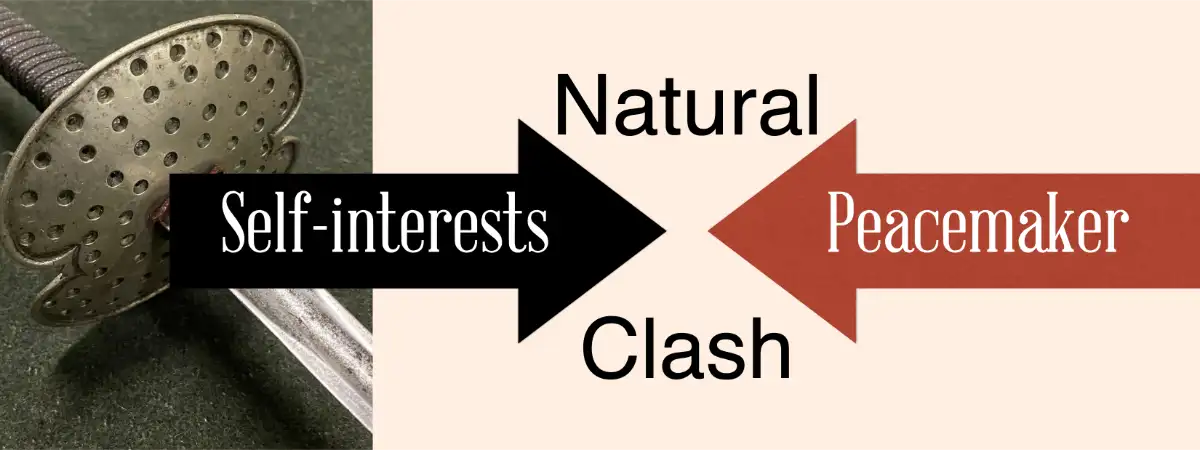
This generation is slipping away from us. Many have not believed in God because, as God’s people, we have not responsibly embraced our calling. We must live in peace as Christians. Talking about peace, pretending peace, and playing peace are entirely unacceptable. We are Christ’s ambassadors. Our swords of self-interest must be set aside and replaced with humble hearts of mercy, where we genuinely want others to succeed. Time is of the essence. If you are called a son of God, then you must be a peacemaker.

Study Questions on Matthew 5:9 – Peacemaking
- What does Jesus mean by calling peacemakers “sons of God” in Matthew 5:9?
- Why is self-denial essential in the life of a peacemaker, according to the article?
- How does the article contrast worldly peacemaking with the biblical model of peacemaking?
- What does James 4:1-3 reveal about the root causes of conflict?
- Why is it impossible to be a true peacemaker while harboring selfish interests?
- According to 2 Corinthians 5:18-21, what ministry have all Christians been entrusted with?
- In what ways did Christ model peacemaking, and what did it cost Him?
- What is the relationship between having peace with God and being a peacemaker?
- How should peacemaking begin within our personal relationships and homes?
- How can you practically apply the call to be a peacemaker in your current relationships or church setting?
(The above study questions been provided by AI.)
Related Books and Articles on Peace-making by Paul J. Bucknell
An Examination of Our Theological Conclusions: An Architecture to ...
Paul’s new book explores the pursuit of harmony among Christians.
… unity and delight arise when we engage in scriptural discussions in God's love. The church of God must decisively change its momentum and shift toward unity.
Isaiah 9:6 Names of Christ: Prince of Peace: I Can Receive Christ's ...
Prince of Peace is Jesus. Without His peace, I am competitive, selfishly ambitious, and covetous; I am not able to prioritize good relationships with others.
Three Enemies of Peace- Slide #07_3
Three Enemies of Peace ... Anxieties, stress and fears are three enemies to peace. Peace is the absence of trouble, the presence of God. We will regularly meet up …
Colossians 2:1-7 Rooted in the Riches of Christ | Biblical ...
For it was the Father's good pleasure for all the fulness to dwell in Him, and through Him to reconcile all things to Himself, having made ...
Should Couples Reveal Troubles From the Past? Growing in ...
Your goal now is to make peace and reconcile. “I know I don't ... “Now all these things are from God, who reconciled us to Himself …
Matthew 6:14-15 Why is it so hard to forgive? Part 3 | Biblical ...
While we can approach reconciling parties and reach a merger or... Yes, but how do you reconcile Jesus' statement with Matthew 6:14-15?
Ephesians 4:26-27 Be Angry But Don't Sin with Bible Study ...
Isn't all anger sin? How do you reconcile these two messages? What are the special instructions at the tail end of verse 26? What does this ...