Written by Paul J Bucknell on September, 09, 2025
John 3:4-6 What Does it Mean to be Born of Water and Spirit?
“Jesus answered, “Truly, truly, I say to you,
unless one is born of water and the Spirit
he cannot enter into the kingdom of God” (John 3:5 NASB).
There are many ways to interpret John 3:5. Jesus didn’t intend to be confusing, but sometimes people are misled by unsupported ideas, whether implied or stated. We present four interpretations and explain why the fourth is the correct one—because Jesus himself explained it that way! Discover why Jesus points to the necessity of spiritual rebirth, beyond natural birth and religion, in order to see and enter God’s kingdom.
Four Interpretations for John 3:4–6
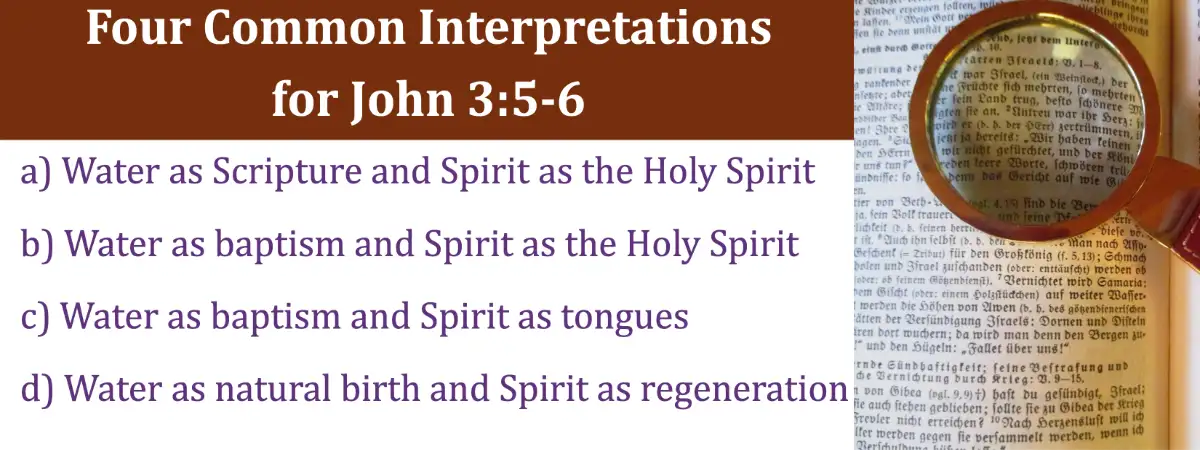
Jesus explained that to enter the kingdom of God, one must be born of water and the Spirit. Jesus was answering Nicodemus’ question: “Nicodemus said to Him, ‘How can a man be born when he is old? He cannot enter a second time into his mother’s womb and be born, can he?’” (John 3:4). Jesus’ answer has been interpreted in various ways:
a) Water as Scripture and Spirit as the Holy Spirit
b) Water as baptism and Spirit as the Holy Spirit
c) Water as baptism and Spirit as tongues
d) Water as natural birth and Spirit as regeneration
The context suggests that natural birth and spiritual rebirth are in mind. Please note that in each interpretation “spirit” is always interpreted as the Holy Spirit—with a capital “S.” This is fine. One makes a conclusion on capital ’S’ or small ’s’ by the context. Only four minor translations of 64 versions use small s (i.e., spirit).
There may be some differences in timing or process, aside from the meaning of the words. For example, does water and the Spirit happen at the same time, or is it a two-step process? Either way, genuine salvation—those born of water and the Spirit—occurs, and people enter God’s kingdom.
Jesus, emphasizing His point with a double ‘Amen' (verse 3,5, “truly, truly"), highlights His seriousness about this matter. Our question is whether Jesus is using another image to explain regeneration or if He is still referring to “born again” as in verses 3-4. We believe it is the same. Let me introduce four major views.
a) Water as Scripture and Spirit as the Holy Spirit
In this interpretation, water symbolizes the Word of God, and the Spirit represents the Spirit of God. When a person hears the word of God, the Spirit of God activates the Gospel (i.e., a washing) within their hearts and minds through conviction, leading to their salvation. Notice the cleansing power of the word: “So that He might sanctify her, having cleansed her by the washing of water with the word” (Eph 5:26).
The seed starts to sprout as water reaches its core, bursting with life (1 Pet 1:23). However, here, water is not the same as the seed, which represents the Word or Gospel. We are saved by hearing the word: “So faith comes from hearing, and hearing by the word of Christ” (Rom 10:17). But water and washing have biblical support. “He saved us, not on the basis of deeds which we have done in righteousness, but according to His mercy, by the washing of regeneration and renewing by the Holy Spirit” (Titus 3:5). In Titus, both water and Spirit are mentioned.
But would Nicodemus first think of water as scripture? Why doesn’t Jesus mention the Word or Scripture as He does in many other places? God spoke (the word of God), and creation came into being. If that is so important, why is Jesus so subtle? This interpretation also doesn’t fit well with the previous conversation. While this interpretation is possible, it’s unlikely.
b) Water as baptism and Spirit as the Holy Spirit
Water is often linked to baptism. People undergo baptism in or with water. (I’ve never seen it not.) John the Baptist immersed those who came to him in the Jordan River. Baptism represents a spiritual renewal, both in faith and life. Many denominations interpret Jesus' command to be baptized through this verse and even associate it directly with the process of conversion. In other words, baptism is viewed as a way to attain salvation. Without baptism, salvation is considered impossible. Other groups, like the Anabaptists, continue to see baptism as crucial, but as an outward sign of God’s Spirit working within the heart.
Water serves as a powerful symbol and is linked to baptism, but Jesus did not explicitly mention baptism here, which one might expect if that interpretation were correct. Water’s connection to baptism is valid but reflects a deeper association with faith in Christ that leads to baptism—specifically, faith in Christ, the Life Giver. Water here does not refer to infant baptism. Baptism is not required for salvation (John 14:6; Titus 3:5) but follows belief. I have rarely seen people in conversation use water as a substitute for baptism, as this interpretation suggests.
We will discuss the Spirit of God below in a parallel interpretation where water still symbolizes baptism.
c) Water as baptism and Spirit as tongues
All believers see the Spirit here as referring to the Holy Spirit. Charismatics have a unique view, considering the gift of tongues as a sign of the Holy Spirit’s work in their lives, as exemplified in Acts. John the Baptist predicted this work, saying, “John answered and said to them all, “As for me, I baptize you with water; but One is coming who is mightier than I, and I am not fit to untie the thong of His sandals; He will baptize you with the Holy Spirit and fire” (Luke 3:16).
Many charismatics, coming from traditional denominations that baptize infants, also interpret Jesus’ mention of water as baptism. They see water baptism as the initiation into the church and view tongue-speaking as God’s declaration that the Spirit is genuinely working in and saving a person.
However, we have issues with both water, referring to baptism (as mentioned earlier), and the requirement that speaking in tongues (i.e., speaking in an unknown foreign language) be a necessary sign for salvation. As I explained in my book, Life in the Spirit!, these special Acts occurrences proved that the Jews and Apostles that the Gentiles experienced the same salvation and so have equal footing in the church (Acts 1:8). The fire does represent the work of the Holy Spirit, which is understood and accepted, but the receiving of the Spirit should not be marked by speaking an unknown foreign language. God has done a marvelous work saving people in these old denominations, but let this experience not confuse Jesus’ teaching. Nicodemus would not have understood this.
d) Water as natural birth and Spirit as regeneration
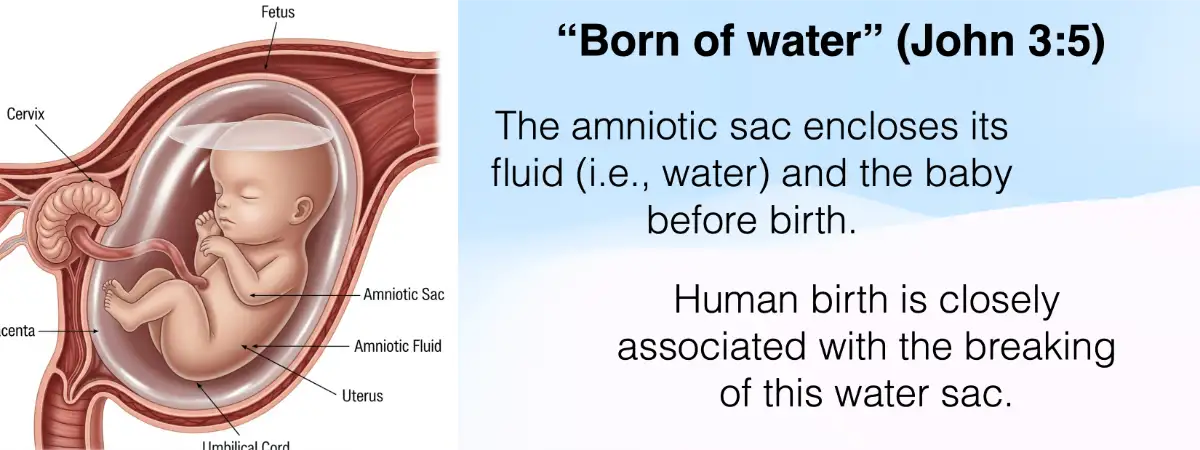
Like the previous three points, the Spirit refers to the work of the Holy Spirit in saving individuals, “so is everyone who is born of the Spirit” (John 3:8). What differs is the understanding of water as referring to one’s natural birth. This fits well into the discussion on being “born again.” Natural birth starts with the baby being in a water sac, which links water to the first birth from the mother. When the water breaks, the baby is born. Thus, water symbolizes natural birth, while Spirit symbolizes spiritual rebirth.
“That which is born of the flesh is flesh, and that which is born of the Spirit is spirit” (John 3:6).
Jesus restates this meaning and assures us that this phrase is part of the same process of being “born again.” “Do not be amazed that I said to you, ‘You must be born again.’ The wind blows where it wishes, and you hear its sound, but you do not know where it comes from or where it is going; so is everyone who is born of the Spirit” (John 3:7-8).
Furthermore, Jesus clearly refers, in context, to both a natural and a spiritual birth. “That which is born of the flesh is flesh, and that which is born of the Spirit is spirit” (John 3:6). The flesh here undoubtedly refers to human birth and the body. People are alive at this point, but since they are spiritually dead, they need to be born of God’s Spirit. Nicodemus would interpret this verse in this way, and if verse 5 is a bit unclear, Jesus’ explanation in verse 6 clarifies any doubts about His meaning.
Conclusion
Jesus, then, is emphasizing the need for God’s Spirit to work in individuals to give them new life in order to enter His kingdom. Natural birth and religion are insufficient. Much can be said about this kingdom and Jesus’ full meaning, but we cannot delve into that here.
Water does not refer to the baptism ritual, though it is necessary and expected. Instead, as the context clearly shows, water symbolizes natural birth, and the Spirit refers to God’s powerful Spirit working in every truly saved person. Jesus neither states nor hints at the importance of proof through speaking in an unknown foreign language.
In simple terms, Jesus is emphasizing that regardless of one’s religious or other life experiences, the Holy Spirit is essential for effective work in one’s life, leading to salvation. A person has experienced one birth, his natural one, but he needs God’s spiritual work. “Truly, truly, I say to you, unless one is born again he cannot see the kingdom of God” (John 3:3). This interpretation would make much sense to Nicodemus, even as he was trying to understand his life and the many religious Jews about him.
10 Study Questions on John 3:4-6
1. What did Jesus mean by being 'born of water and the Spirit' in John 3:5?
2. Why was Nicodemus confused about the idea of being 'born again'?
3. What are the four main interpretations of 'water' in John 3:5?
4. Which interpretation fits best with the context of verses 3–6, and why?
5. How does John 3:6 (“That which is born of flesh is flesh…”) clarify Jesus’ meaning?
6. Why is baptism not required for salvation, though it is important?
7. How does the Holy Spirit bring about spiritual rebirth in a person’s life?
8. Why is natural birth alone insufficient for entering God’s kingdom?
9. What role does faith in Christ play in experiencing new birth?
10. How can we explain the necessity of being 'born again' to someone today?