Written by Paul J Bucknell on April, 07, 2026
Ephesians 2:1–10 The Supremacy of God’s Grace
Ephesians 2:1–10 is one of the most theologically dense and emotionally stirring passages in all of Scripture. In just ten verses, the apostle Paul takes us from the depths of spiritual death to the heights of being seated with Christ in heavenly places — and he does it by revealing one of the most countercultural truths in the Bible: you didn’t earn any of this.
____________________
The themes of grace and mercy fill God's redemptive plans
The themes of grace and mercy are rooted in the redemption of Jesus Christ, as seen in Ephesians chapter 2, which closely follows chapter 1. Ephesians 1 beautifully describes God’s extravagant plan for His people. Similar to the two parts of the Book of Exodus, Paul first presents the plan for the spiritual temple (chapter 1), and then explains its actual construction (chapter 2). You will remember Paul’s prayer in chapter 1: “18 I pray that the eyes of your heart may be enlightened, so that you will know what is the hope of His calling, what are the riches of the glory of His inheritance in the saints, 19 and what is the surpassing greatness of His power toward us who believe” (Eph 1:18-19).
Paul specifically addresses in 2:1-10 how the Lord established this redemptive plan in space and time within the church, which explains the common use of the past tense (2:4-6). This is not just a speculation about what God planned to do, but a demonstration that God fulfilled His purpose by sending His Son to die for us. He has established His spiritual temple right in Ephesus, and now, all around the world.
The famous temple in Ephesus, dedicated to the goddess Artemis and regarded by some as the greatest of the Seven Wonders of the World, significantly influenced the city. They say this goddess came from heaven, which is why the temple was built around it. Remember the cry of the Ephesians in Acts 19:34: “But when they recognized that he was a Jew, a single outcry arose from them all as they shouted for about two hours, ‘Great is Artemis of the Ephesians!’” The preaching of the Gospel completely replaced the importance of the misunderstood meteorite. Instead, God sent His Son, Jesus Christ. This was not a random event, but God intentionally and purposefully sent Him according to His plan and prophecies.
Let’s read Ephesians 2:1-10.
1 And you were dead in your trespasses and sins, 2 in which you formerly walked according to the course of this world, according to the prince of the power of the air, of the spirit that is now working in the sons of disobedience. 3 Among them we too all formerly lived in the lusts of our flesh, indulging the desires of the flesh and of the mind, and were by nature children of wrath, even as the rest. 4 But God, being rich in mercy, because of His great love with which He loved us, 5 even when we were dead in our transgressions, made us alive together with Christ (by grace you have been saved), 6 and raised us up with Him, and seated us with Him in the heavenly places in Christ Jesus, 7 so that in the ages to come He might show the surpassing riches of His grace in kindness toward us in Christ Jesus. 8 For by grace you have been saved through faith; and that not of yourselves, it is the gift of God; 9 not as a result of works, so that no one may boast. 10 For we are His workmanship, created in Christ Jesus for good works, which God prepared beforehand so that we would walk in them.
An Overview
We can trace the amazing grace of the Gospel through the three movements in Ephesians 2:1-10. They all help reveal God’s incredible grace in His salvation work and interactions with His people. While we include some details, this study mainly offers a broad overview—a complete picture of God’s purposes for His redemptive plan. If there is a great building, we naturally wonder about its purpose. The more impressive the structure, the stronger the motivation to build it, and the same applies to God’s grand eternal plan in sending Jesus Christ.
1. Separated from His Grace (Eph 2:1-3)
2. Saved by His Grace (Eph 2:4-6)
3. Showcased for His Grace (Eph 2:7-10)
Main point: God has demonstrated His incredible kindness to us so that we can more intentionally and gratefully join Him in doing the good works He has called us to.
Ephesians 2:1-10 elevates us beyond our needs and personal concerns to God’s plan of salvation, placing us in everyday life to help anyone anywhere as the Holy Spirit guides us.
1. Separated from His Grace (Eph 2:1-3)
1 And you were dead in your trespasses and sins, 2 in which you formerly walked according to the course of this world, according to the prince of the power of the air, of the spirit that is now working in the sons of disobedience. 3 Among them we too all formerly lived in the lusts of our flesh, indulging the desires of the flesh and of the mind, and were by nature children of wrath, even as the rest.
(1) A Description of Man’s State (2:1)
These opening verses, among other purposes, address skeptics who mock the idea that we need God or a Savior. By describing our true natural offensive state in contrast to those who believe they can earn God’s favor through their works, obedience, or social status, the importance of the Gospel becomes much clearer. Let’s examine with Paul these unbreakable prison bars that imprison us in God’s anger. Without a taste of freedom or righteousness, people become content with their dire situation. However, Paul burst this notion, opened the casket, and called us dead.
There are two words that describe our sins in verse 1. “Offenses” (παραπτομα par-ap’-to-mah) refers to a lapse, a deviation from what is standard and good. Sins (Harmatia) describe the places where we have fallen short (cf. Rom 3:23). Harmatia literally means ‘missed the mark.’ Think of an arrow that is shot but does not hit the target. We have missed the purpose for which we were designed. God created us, but we have spent our energy, mind, and body on other things. It does us no good to hide our sins and pretend we are good. Though called to be good, and these two nouns highlight standards and expectations planted within us by our holy God, we have missed the mark. Our salvation only begins when we admit how we have fallen. To go along with the world’s self-esteem message, “I’m not so bad,” is delusional.
His description of death should be enough: “And you were dead.” We are spiritually dead, meaning we are completely unresponsive to God and His good ways. All forms of communication, activity, and awareness—signs of life—have stopped. He or she is now spiritually dead, departed, and inanimate. The Greek word ‘nekros’ has an English derivative, ‘necromancy,’ which means communication with the dead.
(2) A Description of Man’s World (2:2)
Paul continues through these verses, emphasizing our complete hopelessness apart from Christ. The problem is not just our sins but the overwhelming dark powers around us. Three are listed.
- “According to the course of this world.”
We rarely see people crying out against this world’s ways, though they grumble when it does not favor them. This is what they know and like. - “According to the prince of the power of the air.”
This ‘prince’ refers to Satan or the devil. “The God of peace will soon crush Satan under your feet” (Romans 16:20 ). - “Of the spirit that is now working in the sons of disobedience.”
This reference to ‘the spirit’ describes the unobserved, persuasive mindset that settles in our hearts and minds. John speaks of the spirit of antichrist here. “And every spirit that does not confess Jesus is not from God; this is the spirit of the antichrist, of which you have heard that it is coming, and now it is already in the world” (1 John 4:3). The same spirit, called the world, attempts to influence our minds, persistently persuades us (1 John 2:15-17).
We participated in these sins “in which you formerly walked” (2). The dark forces imprisoned us with their dark powers (2).
(3) A Description of Man’s Involvement (2:3)
Our relentless lusts and desires tainted our bodies and minds. Therefore, we were rightfully called “children of wrath.” “We too” (3) emphasizes that the entire human race is depraved and entirely dependent on Christ’s mercy and grace. We are “children of wrath.” If we live contentedly in this dark world, then we undoubtedly belong here. If our speech and actions align with the world’s, then we recognize that this darkness is our home. Paul includes himself, despite his efforts to live righteously, among “Among them we too all formerly lived.”
If we are naturally born as sinners under the curse of His wrath, how then do some propose that we are morally neutral until we hear the Gospel? Our wrath and judgment, as Jesus stated in John 3:36, now rest upon us. We do not mainly need persuasion from man that the Gospel is true, but the making alive, regeneration (John 3:3,7), mentioned in verse 4.
This careful review of our past should increase our awareness of the depths of God’s grace. The inclusion of all people makes us all naturally in dire need of the Gospel for rescue. These verses provide a foundation for understanding this magnificent redemptive plan. It was created, in part, for our need, established by Christ’s death on the cross, but we will see in verses 7-10 the greater, overarching purpose of God.
Even later in the chapter, 2:11-22, Paul reveals the extensive scope of God’s plan for the church. Suffice it to say, this salvation plan challenges the idea of the world’s supposed innocence. Because of this need, God’s great redemption plan has been put into action, and His brilliant grace has become clearer. Let’s take a closer look at how it was implemented when Christ came to earth.
2. Saved by His Grace (Eph 2:4-6)
4 But God, being rich in mercy, because of His great love with which He loved us, 5 even when we were dead in our transgressions, made us alive together with Christ (by grace you have been saved), 6 and raised us up with Him, and seated us with Him in the heavenly places in Christ Jesus.
The depth of meaning in these verses requires at least two ways to explain it: Redemptive Transformation and Words Matter. The first emphasizes power, action, and change through the verbs, while the second is more subtle, providing a deeper understanding of what God has done by revealing God’s motives in the nouns.
This section makes a sudden shift with ‘But God.’ That was man apart from God. But now, we see God’s intervention in our lives. Mankind needs the infusion of God’s mighty grace, saving them from their damnation. God has chosen to display His marvelous grace in His people and create a new spiritual temple. Man does not perform the conversion; God does. Man is honored with sharing the glorious Gospel of Jesus Christ, but only God marvelously saves and transforms us. Let’s observe the process.
* Redemptive Transformation
“Dead in our transgressions” is reaffirmed amidst these three powerfully transformative verbs to emphasize man’s helplessness and God’s wondrous grace. Death, like a prison, offers no transformation, but it more accurately describes God’s work that begins with Christ.
Paul intentionally uses three words to describe the entire transformative process that all Christians experience. We do not undergo these changes through feelings but through our position. A newborn barely understands its new life, let alone its potential and purpose. They happen to us and later reveal their powerful impact. This is similar to the children of God who are newborn.
(1) “Made us alive with Christ.”
“Made us alive with Christ” is a new phrase that Paul first coined. It’s also used only in Col 2:13. Paul created the Greek word συζωοποιέω to convey a theological insight. By adding ‘sun’ (in red) to the Greek word for ‘to make alive,’ he begins a complete trio describing our Christian lives, all brought into being through Christ. Think the prefix ‘syn,’ as in synonym or syncretic, means ‘together with.’ Paul, understanding that we start bound in spiritual death, first explains how to gain new life. Its crucial to remember the “But God,” the subject when describing these transformations. The ‘syn’ emphasizes the importance of Jesus Christ in this process. Salvation can only be found in Christ Jesus. This first point shows how every believer is made alive through Jesus Christ. This is the same as regeneration or being born again. Like a newborn, it happens to us, although later we will see how faith is similar to the newborn’s first and ongoing breaths.
(2) “Raised us up with Him.”
God also raised us up with Him. It emphasizes God’s power at work in His people, the sustaining of His new life. Later, as growing believers, we will discover there is no energy drawn unless from abiding in Christ and His Word. It is from here that the spiritual discipline of daily meeting with God through prayer and the word of God. The word means to aid or help.
Exodus 23:5 uses the same Greek word in the Septuagint for removing the burden from a fallen mule to help it stand again. Jesus says He will send the Holy Spirit, used over 15 times in Ephesians, as our Helper or Advocate (Greek: paraclete). We are completely dependent on Christ’s Spirit in us, which He gave as a deposit for the full blessing to come (Eph 1:14). This “raised us up in Him” points to the Spirit-given life and energy that propel His people forward in their Christian life and knowledge to live out a Christlike life. It’s helpful to compare this energy to the life that powers our physical bodies, causing our growth and development.
(3) “Seated us with Him.”
“Seated us with Him” completes the trio set of actions God has worked on His people. The verb is mainly used outside of Christian literature to describe wise counselors sitting together to make important judgments and decisions. The only other time it is used in the New Testament is when Peter sits down in the courtyard near the fire during Jesus’ interrogation (Luke 22:55). Seated with Him refers to our shared purpose and to our Lord’s willingness to meet with us. Other concepts also blend into the fullness of this meaning: kingdom of God, rule with Him, “become rich” (1 Cor 4:8).
Though each of these words, including this one, is used in the past tense, indicating that something has already happened. The building of the temple has been completed. All the work has been done through Christ, and by faith, joining Christ, we find our part in it. After a believer is made alive (regeneration and justification), they have a new spiritual life (sanctification), but they need the empowerment to live it out. The phrase “seated with Him in the heavenly places” characterizes the completion of this process (glorification), and yet on earth, it should give us a certain hope.
The phrase, heavenly places (epouranios), is used five times in Ephesians, each reminding us of our temporary life on earth and that we belong to a greater, heavenly kingdom.
Summary
We all have a common start: being spiritually dead, as Paul summarizes in verses 1-3. But God intervened and transformed His chosen people. He uses three words to describe this process, all of which happened in the past in Christ (Greek aorist tenses). Something deeper has occurred in the heavenly realms regarding our lives. He first gave us life, then lifted us up, and seated us in the heavenly places in Christ Jesus. Our heavenly position is meant to increasingly influence our thoughts and actions, unlike the first verses of this chapter, where our earthly lusts controlled us.
(2) Words Matter
Let’s look at three key words Paul uses in verses 1-10. They together signify a rich, enabling way God treats us: mercy (4), love (4), and grace (5,7,8). They overlap in bestowing God’s kindness to the undeserving.
Mercy - “being rich in mercy” demonstrates extreme kindness to forgive, even to the point of dying to secure this mercy for those deserving judgment.
Love - “great love,” with a superlative, elevates the purpose of extending His kindness to the unlovely. It reflects God’s motive to love, not to hurt.
Grace - With emphasis from the repetition, mentioned three times in the first three chapters. Grace differs by showing goodness to the forgiven. It doesn’t just forgive but treats them as His adopted children.
This undeserved treatment is what transforms our completely hopeless situation described in verses 2:1-3. But Paul has a greater goal: to highlight how unworthy we are of such treatment. Considering our worldly ways, look at the incredible kindness of God, pouring out His riches into our lives, all of it entirely undeserved. God powerfully works in us to behold, experience, and testify to God’s amazing grace in Christ working in our lives here on earth.
Summary
We discover that God’s actions toward us are not something that is considered to be automatic or instinctive, even though they genuinely occur. In the same verses above, we see God’s incredible treatment of us, His people. In other words, it did not just happen by chance, but was done out of His mercy, love, and grace. His purpose is to inspire greater wonder and respect for our Lord, shaping our lives and influencing how and why we live. We are not only changed in position but also transformed in character. This will be discussed in the last verses, 7-10, but before that, let me illustrate this greater work through a rocket lift-off.
A Rocket of Grace
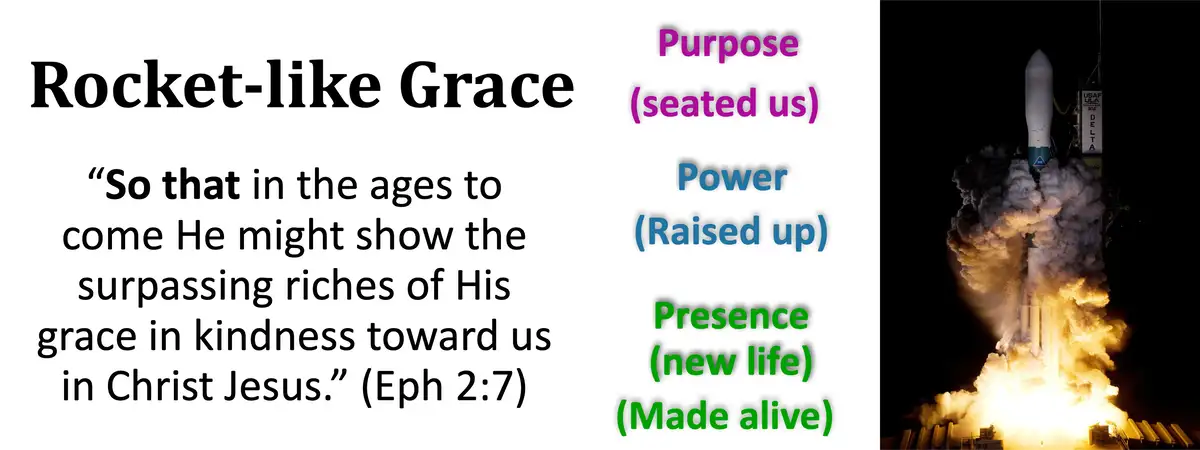
Ephesians 2:1-10 is a powerful passage that takes believers from their lowest point to their highest, transforming them from spiritual death to reigning with Christ. Our new life in Christ is like a rocket launch; the process begins with a tremendous burst of energy. Suddenly, we experience great movement and vitality (Christian life). Spiritually, a new birth has occurred, but we are not left there. That alone is enough to demonstrate the greatness of God’s incredible grace, but it doesn’t end there. Our salvation through Christ’s grace, received by faith, lifts us from the ground where we are all spiritually dead. Salvation is essential. No rocket, no liftoff. But with those boosters—full forgiveness and new life in Christ—Christ guides us, as we will see in later verses, through His grace to do His works.
3. Showcased for His Grace (Eph 2:7-10)
The words “So that” shape the final phase of God’s redemptive plan. God isn’t just interested in launching rockets; He is committed to completing missions. He has goals and purposes, and in His wisdom, He patiently sees them through. Such deep involvement in saving mankind through His Son binds us to God’s eternal purposes for our lives. Without Him, we had nothing; with Christ, we have everything.
7 So that in the ages to come He might show the surpassing riches of His grace in kindness toward us in Christ Jesus. 8 For by grace you have been saved through faith; and that not of yourselves, it is the gift of God; 9 not as a result of works, so that no one may boast. 10 For we are His workmanship, created in Christ Jesus for good works, which God prepared beforehand so that we would walk in them.
These verses color a wonderful description of this last, yet ongoing, stage of Christian life and experience. I identify four purposes.
His eternal purpose (7) is illustrated in the phrase “in the eons to come.” Eon means ages, a way to describe the future. God is stating that what He is doing now with His people and Son will go on into eternity.
His glorious purpose (7) is revealed in the phrase “surpassing riches of His grace,” which depicts the immense glory of His benefits. It’s incredible. His purpose is to demonstrate His unmatched goodness to us, who don’t deserve any of it. This contrast underscores the remarkable nature of God’s grace.
His kind, gracious purpose (8-9) repeatedly emphasizes God’s grace towards us at every step of the salvation process. We are fully accepted before God. We’ll discuss this more shortly.
His significant purpose (10) describes God’s wonderful plans for redeemed mankind, not just in saving us, but in including us in His good works. Again, we will discuss this more.
Characteristics of Salvation (Eph 2:8-9)
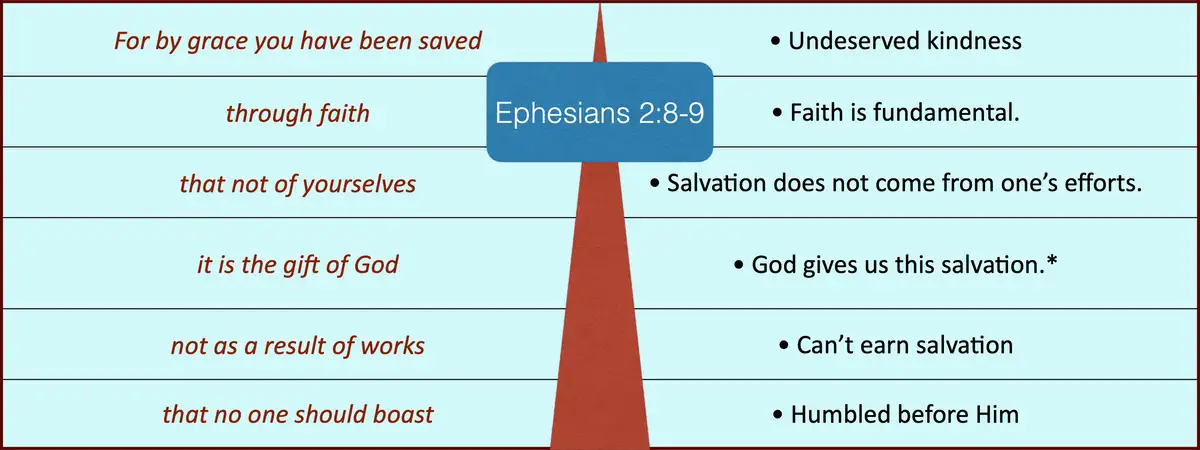
Given the significance of this ultimate description of our salvation, we will explore the six descriptions of salvation in verses 8-9. Together, they show His kindness in a way that enhances our appreciation of His work. We should not leave with the mindset that we deserve salvation, because that completely contradicts what is stated in verses 1-3. Moreover, it diminishes God’s great salvation., which is stated here. If God’s goal is to display His incredible grace, then we should not tarnish His glory with our self-satisfied attitudes.
Let’s briefly observe each point.
1. “For by grace you have been saved” plainly speaks of God’s undeserved kindness. While mercy speaks of our guilt and gained forgiveness, grace announces how God treats us better than we deserve. In other words, God is not just putting up with us, but seeks to lift our status and value.
2. “Through faith” unequivocally describes the means by which our faith contributes to being saved. Faith is not our gift to Him; however, it is God’s gift to us (see point 4). Being spiritually dead requires a special renewing work of the Holy Spirit within us: “but according to His mercy, by the washing of regeneration and renewing by the Holy Spirit” (Titus 3:5). Believe in the Lord Jesus and be saved!
3. “That not of yourselves” emphasizes that salvation is not self-originating, in any respect, but purely stems from God’s special saving efforts. This helps strengthen our understanding of God’s glorious work in us.
4. “It is the gift of God” can refer to salvation as a whole, since it serves as the topic of these verses, but it also could refer to faith itself. The latter is preferred as it stands closer to faith. However, the meaning is essentially the same, as salvation comes through faith or belief in Christ Jesus. We are hidden in Christ’s righteousness.
5. “Not as a result of works” completes the former thoughts: “that not of yourselves,” “by grace, and “through faith.” They all heighten our understanding of God’s gracious kindness in saving us. We could not contribute anything to our salvation. Paul clearly states what many have assumed. Salvation does not come from merit, good or extraordinary works, law-abiding, class, or religion. We are fully cast on God’s grace in providing Jesus Christ as our Savior.
6. “That no one should boast” properly humbles mankind to his proper place, but with a definite purpose of further appreciating God’s glorious work through the salvation process. Paul’s regular conflict with the legalists has led him to carefully consider these arguments.
Verses 8 and 9 powerfully describe the salvation we find in Christ. They are often used to clarify what the Gospel is and isn’t, as the evil one deceptively tries to give confidence where there shouldn’t be any (so people won’t inquire into the Word). He seeks to strip confidence from those who genuinely trust in Christ for salvation.
His Significant Purpose (Eph 2:10)
10 For we are His workmanship, created in Christ Jesus for good works, which God prepared beforehand so that we would walk in them.
Verse 10 is the crown of this section, explaining (“for”) God’s purpose as revealed in verse 7. He reveals a whole new dimension to God’s greater purposes for His people. This is not just an abstract, future hope but a practical outworking of Christian life. Each believer, and the church as a whole, is His workmanship. God has created us to carry out God’s purposes, which are described as good works. Here again, we see God’s goodness around every bend. God manifests His good works, and like in multiplication, He expects further good works to develop from what He has done, providing in the end a fantastic growing display, ever-broadening picture, of His manifested goodness, and with regard to those whom He has redeemed in His mercy and grace.
God has prepared them before we were born and reaches far beyond time itself, in the eons above. But let us complete the picture, as He does. God creates and saves us so we can walk in the paths He has already prepared. He made His people to play an important role in demonstrating His grace. Our salvation provides evidence of this, but what we do afterward further honors Him.
Summary of Ephesians 2:1-10
God revisits our past sins and deadness to once again surprise us with His incredible grace in our salvation. He repeatedly reminds us that salvation depends on His grace and faith—not on ourselves—to deepen our appreciation of His grace. He points out His incredible purpose for our lives: to live out His works through us. We get to join Him in His glorious work now and throughout eternity.
- God made us “for good works.”
- God saved us to carry them out.
- Our job is to discover and do them!
Ephesians 2:1-10 Bible Study Questions
- How does Paul describe the spiritual state of humanity before experiencing God’s grace in Ephesians 2:1-3?
- What three "dark powers" influence those who are separated from God's grace?
- How does being "spiritually dead" differ from just being "religious"?
- What is the significance of the phrase "But God" in the context of this passage?
- Explain the three Greek compound verbs used to describe our new position in Christ (made alive, raised up, seated).
- According to verses 8-9, why is it impossible for someone to boast about their salvation?
- What is the significance of the term “workmanship”?
- How does the Christian view of grace and "doing good,” as mentioned in the lesson, differ from the perspectives of other major world religions?