Written by Paul J Bucknell on September, 13, 2025
2 Peter 1:17 Greek Textual Analysis
Our Purpose
We examine the various possibilities for the original Greek text for 2 Peter 1:17, especially the one phrase, “This is My beloved Son." The full verse in the NASB goes, "For when He received honor and glory from God the Father, such an utterance as this was made to Him by the Majestic Glory, “This is My beloved Son with whom I am well-pleased” (2 Peter 1:17)
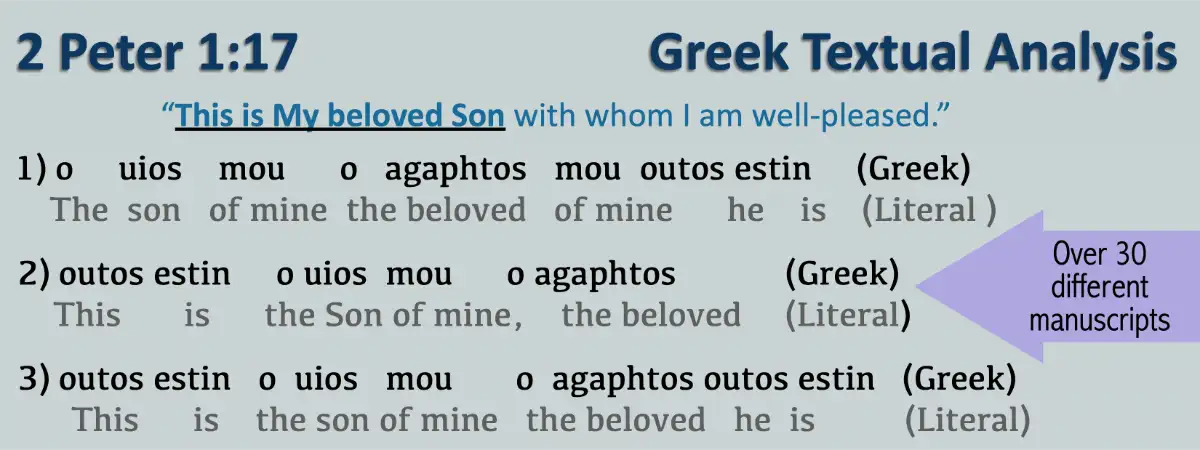
The variance occurs only in one phrase of 2 Peter 1:17, with three main differences outlined below. The Greek is romanized in each case. Below the Greek are the literal English translations (as much as possible). In this case, we can better understand the reasons the text differed. These are word-for-word translations and, therefore, are not smooth English readings. English readers often forget that translations have to be adjusted a bit to sound natural.
Understanding Textual Criticism
Those first studying textual variations might be surprised by how trivial they are. There are no misspellings in this verse, but sometimes there are. However, do remember that the original manuscripts were written in Majuscule up to the 3rd century AD; Uncials, similar but rounded, followed until about the 9th century. This meant the text was composed completely of Greek capitals with no spaces between words and little or no punctuation. The reader had to interpret where to pause.
Take a look at John 1:1 in the Greek.
Uncials: ΕΝΑΡΧΗΗΝΟΛΟΓΟΣΚΑΙΟΛΟΓΟΣΗΝΠΡΟΣΤΟΝΘΕΟΝ
Modern: Ἐν ἀρχῇ ἦν ὁ λόγος, καὶ ὁ λόγος ἦν πρὸς τὸν θεόν…
English: In the beginning was the Word, and the Word was with God.… (NASB)

3 Variations of 2 Peter 1:17
The variance occurs only in the first part of 2 Peter 1:17, with three main differences outlined below.
1) o uios mou o agaphtos mou outos estin (Greek romanized)
The son of mine the beloved of mine he is (Literal )
Supporting texts: r72 B copsa? bo?
2) outos estin o uios mou o agaphtos (Greek)
This is the Son of mine, the beloved (Literal)
Supporting texts: a A C K q 049 056 (0142 omit mou)
0209 33 81 88 104 181 326 330 436 451 614 629 630 945 1241 1505 1739 1877 1881 2127 2412 2492 2495 Byz Lect m itar, c, dem, div, h, p, z vg syrph, h (copsa?bo? agapytov mou) arm eth? Ps-Oecumeniou Theophlact
3) outos estin o uios mou o agaphtos outos estin (Greek)
This is the son of mine the beloved he is (Literal)
Supporting texts: P
Summary
The variations convey the same meaning, but are differently expressed. Perhaps the difference occurred because a copyist slipped up or, more probably in this case, rephrased it in a way that reflected their language style.
TIPS states this thought for translators,
“This is my Son, my Beloved” is the wording in many important Greek manuscripts, as the Revised Standard Version footnote makes clear, while some others have my beloved Son. In translating this, however, there may not be that much difference between the two versions of the text, since they practically come out the same in the translation. In many languages, for instance, it is not natural to say “my son, my beloved,” but it is perfectly natural to say “my beloved son” or “my son whom I love.” The adjustments made will be translational decisions rather than decisions based on the text and its interpretation.”
Only one version is correct, of course. The difference is minor and causes no problems. In this case, the second variant has the most supporting texts (i.e., manuscripts) and was probably done for clearer understanding. This has been an introductory study, not exploring why each variation might exist, but only to show that the Scriptures are highly trustworthy.
Key Points
• Three textual variants exist for 2 Peter 1:17, but all affirm the same meaning.
• The second variant has the strongest manuscript support. Almost all manuscripts support it.
• Textual differences arose from scribal mistakes and the desire to properly communicate, not theological disputes.
•Textual criticism aids us in dispelling doubts about the reliability of the New Testament.
Study Questions for 2 Peter 1:17's study on its Greek text
1. What are the three main textual variants of 2 Peter 1:17?
2. What are one or two reasons scribes sometimes create small variations in manuscripts?
3. Which variant of 2 Peter 1:17 has the widest manuscript support?
4. How does this study strengthen our confidence in the reliability of Scripture?