
Written by Paul J Bucknell on July, 19, 2025
2 John 9-10 Going Too Far: What 2 John 9–10 Teaches About the Incarnation and False Teaching
9 Anyone who goes too far and does not abide in the teaching of Christ, does not have God; the one who abides in the teaching, he has both the Father and the Son. 10 If anyone comes to you and does not bring this teaching, do not receive him into your house, and do not give him a greeting. (2 John 9-10, NASB)
What does John mean by “too far” in verse 9? The answer plays a crucial role in understanding 2 John, as well as the challenges the church faced during John’s time. In the same verse, “too far” is equated with “not abide in the teaching of Christ.” The belief of these individuals who went “too far” undermines one or more core truths that Jesus Christ taught, resulting in a faith that is incompatible with Christ’s lifestyle and teachings.
John’s Assurance (2 John 1-6)
John the Apostle does not aim to confuse believers who affirm Jesus as their Lord and Savior. He sincerely addresses “All who know the truth” (2 John 1) or “that we love one another” (2 John 5). By God’s grace, we can find peace by abiding in and living according to Christ’s teachings, even if our doctrinal knowledge is limited. Our confidence stems from our faith, confirmed by the Holy Spirit through the Gospel message in our hearts (1 John 5:10). We have faith in Jesus Christ and possess eternal life (1 John 5:13).
John’s Caution (2 John 7-11)
John’s caution begins in verse 7.
“For many deceivers have gone out into the world, those who do not acknowledge Jesus Christ as coming in the flesh. This is the deceiver and the antichrist.” (2 John 7)
John identifies these deceivers or infiltrators as those who “Do not acknowledge Jesus Christ as coming in the flesh” (2 John 7). This context is essential for understanding John’s warning of not “going too far” in verse 9.
Once again, John is not trying to confuse saints about their faith by suggesting they must believe many doctrines, but he urges them to stay steadfast and not be swayed by false teachers who demand they lessen their faith in Jesus the Messiah.
Jesus does not present a checklist of beliefs necessary for salvation but instead calls us to trust in Him. “Truly, truly, I say to you, he who hears My word, and believes Him who sent Me, has eternal life” (John 5:24). This teaching quietly assumes a parallel teaching of faith in the Father who sent His only Son, the Almighty Creator God, to whom we are accountable. John regularly emphasizes the Father’s relationship with the Son, even here in 2 John, “from God the Father and from Jesus Christ, the Son of the Father, in truth and love” (2 John 3).
“Goes too far” (2 John 9)
John is writing to believers who are encountering, in Paul’s terms, a different gospel. He goes so far as to call these false teachers deceivers (2 John 7). Interestingly, he continues to state, “This is the deceiver and the antichrist” (2 John 7), implying that all deceivers are backed and spawned by the antichrist. Belief in Christ becomes corrupted as the evil one infiltrates the minds of professing believers, sowing doubts and eroding their faith. The evil spirit of the antichrist influenced these false teachers (compare 1 John 2:18).
John is clearly warning the recipients of his letter, but also the church in general. But what exactly is the false teaching? John specifically states, “Those who do not acknowledge Jesus Christ as coming in the flesh” (2 John 7). There are multiple factors to think about. If we look back at early church history, we will find two prominent deviations or cults associated with such teaching.
Docetism and Gnosticism denied that Jesus came in the flesh. This does not mean they denied Jesus Christ’s coming, but that they refused to accept that He took on a human body. They associated the body with delusion, sinfulness, evil, and unholiness. This worldly mindset originated from the Greeks (i.e., Hellenism), who considered the spiritual as ideal, holy, and pure. It concluded that God could never take on a physical form (i.e., the flesh). The spirit is incompatible with the flesh. Gnosticism variously incorporated this fundamental mindset into its different branches.
However, the Gospels stress that the Father sent His Son, who was born (i.e., incarnated) as a human being. We, like them, are to oppose false teachings about Christ, no matter what societal pressures or media platform might promote alternative understandings. 2 John is a testimony of how the apostles fought this Hellenistic influence, which compromised the Gospel. The Gospels include the teaching of Christ’s divine nature and His incarnation, which involves being born and living among humans. Jesus claimed to be the Son of God (Mat 16:16) and the Son of Man (Luke 12:8).
Resisting Attacks on our Faith in Christ
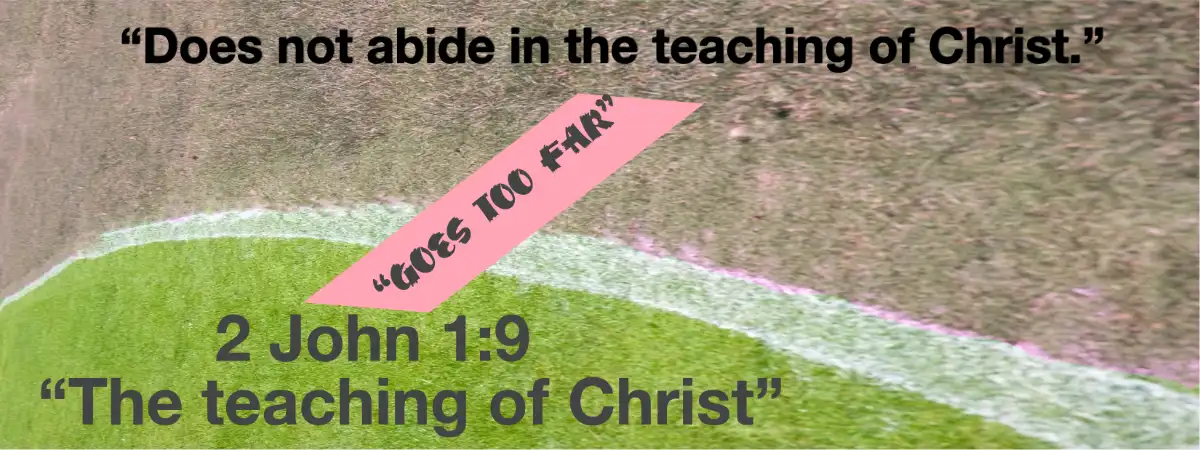
The epistles and early church history confirm this attack on believers regarding the saving faith. Gnosticism evolved into a strong religion with two primary divisions. Christian apologists had to defend the Christian faith against their false teachings. Even today, some believe that lost Gnostic books are still relevant (e.g., the Gospel of Thomas, the Gospel of Mary), but the early church rejected them. Jesus called us to follow His teachings (Matt 28:18-19); however, it’s essential to recognize common boundaries that lead to false teaching—things Jesus did not teach and that oppose the Gospel. We believe it’s crucial to explore what “goes too far” might include. Establishing boundary lines, like in a sports game, helps us stay on track. Without boundaries, it’s challenging to play the game. While truth involves fixed beliefs, we remain focused on our faith in Jesus Christ.
Here are some initial thoughts to help us navigate this teaching while keeping unity.
- Love one another. Jesus’ teaching emphasizes the importance of loving God and others. Abiding in His teachings would necessitate a life devoted to loving others, as stated in 2 John 5: “That we love one another.” Believers don’t dispute this teaching of Christ, but sometimes they accept unloving words and acts when they disagree. Love is patient and willing to apologize as needed. A strong attachment to false teachings can lead to backbiting, pride, and other unloving words. We should walk in love even when false teachers are present. However, love also calls us, as John did, to expose deceivers. Love does not mean, as many believers claim, that we should accept everyone equally into our fellowship of faith.
- Scriptural authority. The “teaching of Christ” (2 John 9) refers to the source of believers’ faith—the teachings from Christ, what Jesus taught. This is confirmed by the context where John spoke, “the one (i.e., commandment) which we have had from the beginning,” that is, from Jesus (2 John 5).
However, John also writes about what we believe regarding Christ, specifically His incarnation. This teaching about Christ comes from what Jesus taught. We must remain focused on the Scriptures, the Word of God. We should recognize and trust Jesus’ authority in appointing the apostles and entrusting them with spreading the truth, including John himself. Even this study on 2 John depends on Jesus’ appointment of John and our trust that Jesus’ Spirit guided John’s writings and their acceptance among believers.
- Maintain scriptural harmony. It’s important to regularly review our teachings, their emphasis, and interpretations in light of other Scriptures. Each teaching should allow other Scriptures to influence our interpretation. Notice John’s repetition of referring to truth in 2 John (1, 2, 3, 4). Truth becomes a standard for believers to gather around in faith, a source they use for guidance on how to believe and follow Jesus Christ, God’s only Son.
- Prioritize the truth. Christians need more clarity on the teachings of the Gospel, not additional doctrine. John made it clear that denying Jesus Christ’s humanity “goes too far.” They have strayed into disbelief regarding the true person of Jesus Christ. Those raised in long Christian traditions have an advantage over those who have never held a Bible. We know the majestic Christmas story, sometimes from memory. What does it teach? Jesus’ incarnation—God became man. Let’s remain focused on Jesus Christ’s person and work as the Apostles’ Creed directs us.
- Remember the goal. The main purpose of John’s insights and warnings is to help us avoid false teachings and instead grow more amazed and obedient to Jesus Christ. Here are some key teachings based on the truth of Jesus taking on a human body.
- God sacrificed someone very dear to Him, His only Son, to adopt us into His family.
- Jesus’ taking on flesh, becoming a human being, brought many troubles, temptations, allurements, and challenges. He suffered much from them.
- Most importantly, Jesus died for us. If he weren’t human, He couldn’t die for us—on our behalf. It is through His offering His righteous life that He could take our penalty and save us. “But God demonstrates His own love toward us, in that while we were yet sinners, Christ died for us’ (Rom 5:8).
- The Book of Hebrews explains how Jesus suffered as a man. He understands and can truly support us during our tough times. “For we do not have a high priest who cannot sympathize with our weaknesses, but One who has been tempted in all things as we are, yet without sin” (Heb 4:15).
- Jesus represents us as the new Adam (Rom 5:12-21).
Jesus’ incarnation is essential to our faith. If we “cross over” and deny that, then we reject the truths related to His becoming human, including our salvation through faith in Him. Let’s not forget Christmas’ marvelous teaching amidst all the celebrations.
We walk in dangerous territory when we relish our speculations and absorb the world’s teachings, speaking of them more than our precious Savior.
Summary
We live in a time of diverse beliefs, where we can instantly access information that seems true but is actually false. Teachings are not made true because we believe in or like them. Jesus, the Son of God, came to live and die as a human; this is mankind’s history, a truth that makes a difference. Our discovery or faith in Jesus doesn’t make Him true, but rather unites us with Him. Let our faith stay focused on the core of Jesus’ teachings. Be careful of false teachings, which operate like a powerful magnet with a strong attraction.
Jesus has come as our Savior; this is our main focus. Let the truth deflect the drawing powers from false teachers, who are animated by the antichrist. John warns the disciples to maintain a bible-centric view of Jesus Christ as Savior (human) and Lord (divine), which assures our love for one another and brings full confidence in the truth.

Study Questions on 2 John
- Read 2 John and state two facts about the letter.
- How many times is the word ‘truth’ used in the first four verses of 2 John? Why might John emphasize it so?
- What verse begins to speak about the deceivers and false teachers? How do you know?
- What does John discuss in 2 John 3-6? Why is that significant?
- What false teaching does John identify in verse 5, and why is it so harmful?
- In the context of 2 John, what might John mean by the words “goes too far” in verse 9?
- Provide an example of a current false teaching where false teachers blend falsehoods into the message about Jesus Christ.
- Summarize how a person is saved according to John 5:24.
Other Articles by Paul Bucknell on 2 John’s themes, including Gnosticism and Docetism
Biblical Faith vs. World's Faith: Counterfeit Faith
Biblical Faith vs. the World's Faith describes counterfeit faith masquerading as humanism and its impact on people's lives.
Titus 3:9-11 : Discerning Conversations - The Bible Teaching ...
I rarely argue with many doctrines and false teachings. You do not often see me doing this, not because I do not like to, but because I find it as Paul had said, not ...
Pastoral Epistles Overview: 1 Timothy, 2 Timothy and Titus
In this case inefficient or nonexistent policies enabled false teachers to exert undue ... Each new wave of false doctrine leads to clearer standards.
Antichrist in the Bible: What does the Bible say about the Antichrist ...
Any false teaching that undermines the Gospel teaching is from the ... of Antichrist, which equally stirs up false teachers and antichrists ...
Reincarnation: Truth or Myth? | Biblical Foundations for Freedom
Those who believe this false teaching view reincarnation as a curse or ... reincarnation distorts Biblical teachings on sin, forgiveness, ...
Good Works and Salvation shows how the many false teachings regarding salvation are no match for the beautiful salvation by faith in Christ Jesus alone!
Acts 20:28-30 Detecting Error to Protect Christian groups
- False doctrine. A cult deviates from one or more major Christian doctrines. · 2) Evil ways. A cult often encourages evil practices. · 3) Controlling or …
The Origin of the Bible: The Extent of the Bible
They are heretical and most often books of cultic movements such as the Gnostics, Docetists, etc. NT Examples: Gospel of Thomas, Gospel of Peter, Gospel of ...
Antichrist in the Bible: What does the Bible say about the Antichrist ...
The early church faced the Gospel-denying cult called Gnostics because of their assumptions from Greek philosophy (i.e., Docetism), …
Acts 8:9-24 Simon Magus & Incipient Gnosticism
Gnosticism. They all believed that their spiritual nature was caught in evil fleshly bodies. Redemption could be had only by gaining special 'gnosis' which ...
1 Timothy and Gnosticism: A Case for Goodness
A Case for Goodness is a study on the presence of Gnosticism in 1 Timothy and the reason Paul so focused on goodness and contentment.
1 Timothy 3:14-16 The Church's Confession of Faith | Biblical ...
False teaching, known as Gnosticism, mixed Greek notions with the Bible, ... The Gnostics presumed that human flesh was evil.