Written by Paul J Bucknell on June, 27, 2025
1 Corinthians 8-10 Humility Gained, Grace Given
An Introduction to 1 Corinthians
Paul in Corinthians addresses the common causes of factions within the church, emphasizing their tendency to foster arrogance and carnality. He also highlights the beauty of living in the Spirit of God. The difference between the acts of the flesh and the Spirit is clear in our world, just as it was in Corinth, a prominent Greek city.
The Apostle Paul wrote the letter of 1 Corinthians to the believers in Corinth for two main reasons. In chapters 1-6, he responds to their reports, while in chapters 7-16, he addresses their letter to him, in which they asked about various church issues.
It helps to see patterns to grasp Paul’s intended purpose for each section more quickly. For example, in the latter half of the book, chapters 7-16 are comprised of six sections, each beginning with the phrase “Now concerning.” Our section for this article starts similarly with “Now concerning things sacrificed to idols” (1 Cor 8:1). By observing this, the reader can more quickly jump into the issue being discussed.
To be honest, “things sacrificed to idols” is not a common issue in the West, but in many places, not much has changed. Only the names and figures of the idols might be different. The pressure to eat meats offered to idols can vary. For example, when I was a missionary in Taiwan in the 1980s, I remember only once a person, an unbeliever, told me not to eat a certain food because it was offered to an idol. Perhaps this broader acceptance is due to a greater understanding and acceptance of different religions. I followed Paul’s advice, “If someone is sensitive to the issue of meat sacrificed to the idols, then don’t eat it.”
A General Overview
Chapter 8 is difficult to understand. There are many unfamiliar background issues that the Corinthians were aware of.
- One odd issue was Paul’s focus on knowledge; this chapter mentions the word five times. This focus on private or secret knowledge would eventually develop into a full-blown cult called Gnosticism. At this point, it was just starting to take shape. The focus was present and sometimes made some believers insensitive to the church’s needs.
- Another issue, already mentioned, is the unfamiliarity with the problem of eating foods sacrificed to idols. Not being sensitive to it makes it easy to overlook this section—but don’t! We have crucial lessons that Paul teaches. Paul discusses these two sacrificial issues in chapter 10. One concerns the careless attitude some believers have toward attending and participating in these idol feasts. The meat is not the main concern here; rather, it is the demons behind the idols (1 Cor 10:14-22). The other issue involves buying and eating foods dedicated to idols but left uneaten. These meats were sold, possibly at a discount, at food markets. Was it acceptable to buy and eat them? (1 Cor 10:23-30)
- The third issue, perhaps the most obvious, is the tension between those who thought it was acceptable to eat such meats and those coming from a background of idol worship who believed it was wrong. The first group did not believe there were such gods, so they felt free, but they were insensitive. The other group felt constrained because they were not fully free to eat such meats, knowing in their conscience that it was wrong.
Paul will explore this issue more thoroughly as we discuss 1 Corinthians 8-10 from three perspectives.
An Overview
Let’s gain a clearer understanding of these three chapters, though our main focus will be on chapter 8.
1. Understanding Humility (Ch. 8)
Humility incorporates love into our thinking.
Humility helps us understand and live within the full scope of Christian grace and truth. The world struggles between the two, but in Christ (John 1:14-17) we can live empowered by God’s full grace. We must not choose between truth and love but practice both. Paul shows us how two groups with different theological views and practices can coexist in harmony.
2. Exemplifying Humility (ch. 9)
Humility includes sacrifices in our lives.
Humility allows us to prioritize the welfare of God’s people over our preferences, basic desires, privileges, and rights. Paul uses chapter 9 to demonstrate how he does this. “15 But I have used none of these things.” “19 For though I am free from all men, I have made myself a slave to all, so that I may win more.”
3. Demonstrating Humility (ch. 10)
Humility means taking people’s needs into account when making decisions.
Humility helps us all honestly evaluate our temptations in a way that prioritizes Christ’s way of life over our desires. This encourages us to regularly reconsider our situations to build others up. “23 All things are lawful, but not all things are profitable. All things are lawful, but not all things edify. 24 Let no one seek his own good, but that of his neighbor.”
1 Corinthians 11:1
Let’s summarize these three chapters from 1 Corinthians 11:1, the last verse in this section. Although we would typically consider 10:32 to close this section, it appears that the next verse, 11:1, is meant for that. The verse numbers are man-made, and sometimes they contain errors. In any case, verse 1 provides a remarkable summary of chapters 8-10.
Paul openly states, “Be imitators of me, just as I also am of Christ.” The verse discusses three groups or individuals, each covered in a separate chapter: Christ (8), Paul (9), and us, the church (10). While Paul shares his life as an example, it is based on Christ Himself. Nonetheless, Paul also encourages believers to follow this pattern.
Let me introduce the example of Christ before explaining the verses. I believe it helps us keep the many arguments focused, as Paul exhorted us to do in 11:1, “Be imitators of Christ.” This diagram is invaluable for understanding the divisions we often see or experience.
Paul will go on to highlight how overconfidence and insensitivity create significant difficulties within different groups. The world divides truth and love, pushing them toward extremes; the worldly church often imitates the world. Satan attempts to steer us toward one extreme or the other—either uncensored freedom or legalism. But if we follow Christ, He unites truth and love. (I’ll provide the full report later.)
The Corinthian problems worsened when they equated their knowledge with truth. Isn’t this a common problem? Doctrine often divides God’s people rather than unites them! Christ unites His followers! God’s purpose is to bring both these aspects together.
Christ protects us from the world’s extremism by uniting grace with truth. God is light (1 John 1:5). God is love (1 John 4:8). Which is right? The world cannot understand both. It’s only God who perfectly unites them in Christ. No doubt you have met those who reject the church because it isn’t faithful to the truth, or others who avoid it due to unloving Christians. The first issue is clear, but how can we address this? Some of us love the truth and insist on living by it, even willing to argue for this or that. The problem is that, because of our arrogance, we can be insensitive to others. Humility helps the self-righteous see their sin and imperfection before God.
Exposition of 1 Corinthians 8:1-4
Is it more important to be right or to maintain good relationships? Of course, both are valid. It’s difficult—extremely difficult—and nearly impossible to do this when you know you are in the right, though. Part of our problem is that we confuse our knowledge with the truth. Another issue is that we do not treat love as a truth. Paul introduces a ‘greater’ right. If we are right, can we be more right? Yes. This reduces the excessive pride in our arrogance. Knowledge is important, but has its limitations, especially without love.
In 1 Corinthians 8, Paul helps us navigate these mined waters safely to reach our desired goal. We need to reflect on our objective. Paul wanted them to remain focused on truth while living with mercy and kindness.
1 Corinthians 8:1-4
Paul writes to those who asked about eating food offered to idols. Some believe they can eat such meat because they think idols don't truly exist. Others are very sensitive even to eating leftover meat from sacrifices in the market. Let’s work through this as we carefully examine the text.
1 Now concerning things sacrificed to idols, we know that we all have knowledge. Knowledge makes arrogant, but love edifies. 2 If anyone supposes that he knows anything, he has not yet known as he ought to know; 3 but if anyone loves God, he is known by Him. 4 Therefore concerning the eating of things sacrificed to idols, we know that there is no such thing as an idol in the world, and that there is no God but one. (NASB)
Idol sacrifices (1 Corinthians 8:1,4a)
The phrase in verse 1, “Now concerning” (Greek: Περὶ δὲ), appears six times in the later part of 1 Corinthians (7:1; 7:25; 8:1; 12:1; 16:1, 12), specifically in chapters 7-16. This repetition highlights the issues the Corinthians raised to Paul in a letter. The new issue mentioned in verse 1 begins in 8:1 and continues through to the end of chapter 11, mainly focusing on knowledge and discernment.
Paul highlights the first issue in verse 1, where he clearly states the problem, “things sacrificed to idols,” but more specifically defines his main topic in verse 4: “eating of things sacrificed to idols.” Some, who knew there is only one God, ate food sacrificed to idols without thinking. There were two kinds: first, those offered at feasts, and second, the leftovers that were later sold in the market. The Corinthians wrote to Paul asking for advice on how their church could best operate with one group, though correct, who were negatively influencing the “weak” brothers.
“We all have knowledge” (1 Corinthians 8:1-3)
The first group gained confidence in their knowledge, which they believed to be the truth. This group was correct; there is only one God. Their use of ‘knowledge’ in verse 1 emphasizes their confidence to eat any food, including food sacrificed to idols. The word “knowledge” is used to identify this specific group and appears five times in this chapter (8:1, 1, 7, 9, 11).
This freed them from worries about eating meat from such sacrifices. Idols are nothing, so the meat sacrificed to them is neither better nor worse. However, Paul weakens their confidence in knowledge by broadening the perspective, saying, “We all have knowledge.” He downplays the distinctions among groups in hopes of humbling them. This also encourages the weaker brothers to more confidently accept the truth. Paul then begins to argue that they are one body, again reducing the differences between groups, which can cause conflict and reduce love.
Paul acknowledged that there is only one God, but he, as discussed, expanded this idea to include all believers, thereby removing this group’s exclusive claim to this knowledge. In verses 4-6, he shifts his argument by redefining this one God. He likely did this to reduce this group's arrogance, since they all believe in that one God.
“Knowledge makes arrogant”
Their knowledge gave them an edge on matters, fostering arrogance. The Greek word for arrogance means “blown up.” Consider a little balloon filled with air. Their arrogance insinuates that others should possess the same knowledge to be knowledgeable (i.e., great) like them. This ultimately resulted in a bit of pressure on those weaker in faith to compromise.
This attitude is sometimes found among those who hold to the right doctrines or spiritual experiences. Others rely on their understanding of details, business skills, and so on. (Too many churches have split over building projects!) We don't know if this group promotes their knowledge, but it has created an unholy insensitivity toward those “without this knowledge.” Paul derides this arrogance, calling it for what it is, and will speak on it more later.
“Love edifies”
This phrase, “love edifies,” though brief, is powerful. In one statement, Paul reminds the Corinthians and us of the constructive purpose of biblical teaching and life. Paul will expand on this teaching of love later in chapter 13, the love chapter, but even here, Paul emphasizes that love must accompany the Christian’s actions, decisions, and attitudes. Paul critiques their mindset in verses 2-3 to guide them toward establishing a biblical mindset in verses 4-6. Their knowledge was dangerous without love.
Limited Knowledge (1 Corinthians 8:2-4)
“If anyone supposes that he knows anything, he has not yet known as he ought to know; 3 but if anyone loves God, he is known by Him.” (2-3)
Verse 2 is wordy and vague even in different translations. Another version states, “Those who think they know something do not yet know anything as they should” (ERV). When anyone begins to gloat in their selective knowledge, “that he knows anything,” it shows they are missing something! Humility helps a person realize how little they truly know. “He has not yet known as he ought to know.” Paul doesn’t call this person ignorant, but indicates they have taken the wrong approach.
Consider the difference in approach. One can boast about how little they know or how much they know. Which causes division? This is Paul’s point here. Boasting of exclusive knowledge excites certain people, almost seducing them with a sense of privilege, but this boasting reveals how little they understand. Spiritual intrigue, whether derived from doctrine, experience, or insight, demonstrates our collective ignorance. This attitude is harmful to a church.
Paul leads them in the opposite direction— “God knows him.” This is what matters. But what is Paul’s point? He wants this exclusive club to stop thinking they are privy to God or His secrets. He will comment later in the chapter on how this attitude crippled other believers through their confidence. They were right, but wrong. This exposes flaws in many saints who believe the truth always wins, regardless of how many people are scarred in the process. God has chosen all believers to be His own; everyone is special. This sets the foundation for our behavior. Since God specially chooses all believers, we must build each other up (which wasn’t happening).
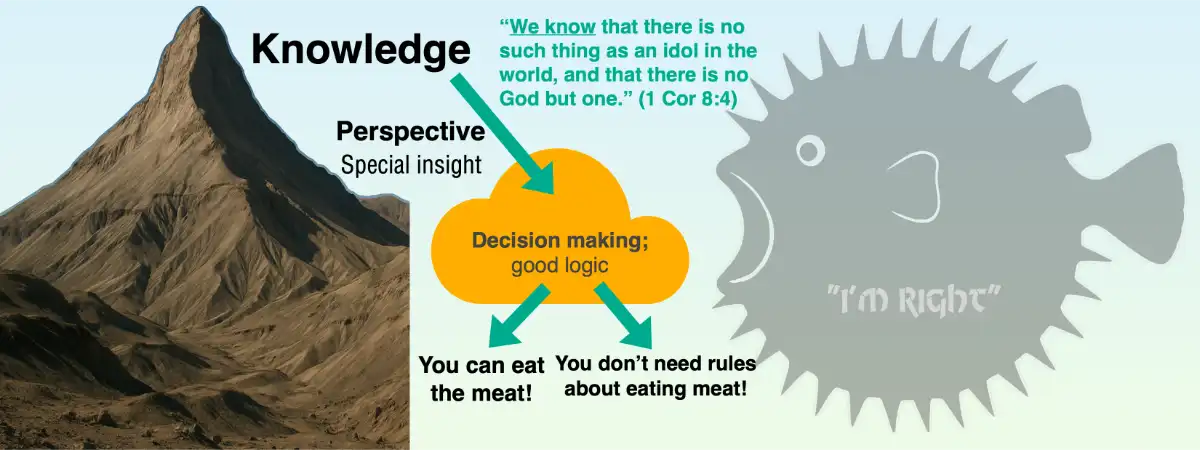
Referring to the above diagram, let us examine how this overconfidence functions. Certain brothers understand the truth. They believe others should know it—after all, it says so in the Bible! They view this issue from a single perspective and thus find themselves on one side—the side of truth. Being so focused on the importance of truth, they are unaware of the truth of love. This group acts on their understanding of truth and makes a clear, logical decision that anyone spiritual should recognize this truth and subsequently join them.
We can hear them say to the others,
"Since we all know there is only one God, stop making decisions that assume these idols are real. Eat meat with us. You don’t need all these rules about eating meat."
We don’t know exactly what they said, but this attitude appears often in situations where we think we understand but actually don’t. Paul is helping them see that since they aren’t being edified, something is wrong. A truth isn’t being properly understood or applied. Remember, truth works alongside love in God’s plan. The group should be praised for consistently applying the truth, but they missed the love aspect. Paul then reveals the full truth. He has two goals: one for the knowledgeable and one for the weak.
1 Corinthians 8:5-6 Improved Knowledge
“4 …There is no God but one. 5 For even if there are so-called gods whether in heaven or on earth, as indeed there are many gods and many lords, 6 yet for us there is but one God, the Father, from whom are all things and we exist for Him; and one Lord, Jesus Christ, by whom are all things, and we exist through Him.” (1 Cor 8:4-6)
Many Gods and Lords (1 Corinthians 8:5)
There is only one God. The apostle compares this to idols. “We know that there is no such thing as an idol in the world, and that there is no God but one.” Idols are just copies. Today, we think of avatars or, even more common, photos. Everyone knows the photo is not the real image.
However, Paul expands on their knowledge further. The phrase “even if” leads to mixed understanding: are these gods real or not? The NET Bible translates “even if” as “If after all.” Paul has stated that the idols are nothing, but he is unwilling to confirm the same for these gods. He acknowledges the existence of “many gods and many lords.” We tend to conclude that if the idols are not real, we can dismiss the gods behind them. He does not do so but instead acknowledges them, as he does in his other writings.
“According to the prince of the power of the air, of the spirit that is now working in the sons of disobedience” (Eph 2:2).
“For our struggle is not against flesh and blood, but against the rulers, against the powers, against the world forces of this darkness, against the spiritual forces of wickedness in the heavenly places” (Eph 6:12).
Paul does not use the terms gods or lords in these other verses, which leads us to conclude that our understanding of local gods or those within the pantheon is not accurate. It’s much more complex, involving many powerful dark beings, “spiritual forces of wickedness.” He doesn’t want those with knowledge to think their understanding is correct and urges them to be more cautious about their beliefs. There is more to this scene than meets the eye. (This is true with all such divisions.) More importantly, though he could say much more, Paul suddenly transitions into verse 6, “yet for us.” He moves from the vague group of dark beings to what we clearly know: the all-powerful God, which we all agree upon. However, he claims that their association with a god is not genuine.
One God (1 Cor 8:6)
Paul clearly explains the greatness of God. We already know these things! All the believers are aware of this! He not only redefines their understanding of the dark world in verse 5 but also of the God of light in verse 6. What they know, they do not fully understand. Regarding the “weak” ones, Paul is teaching them that they can develop more confidence in God. They indeed do not need to fear idols anymore, nor the potential harm that might come to them if they do not worship those idols.
- The Father (6)
- “from whom are all things”
- “we exist for Him”
God reveals Himself as the Father, acknowledging His relationship with the only begotten of God, the Son, the Lord Jesus Christ. This sense of intimacy and relationship in “father” extends far beyond other religions, such as Islam. Paul does not expand on this understanding but instead provides two descriptions for each. We will focus on the context, even as Paul limits his descriptions.
The Father is God from whom all things originate. Paul demonstrates how this truth or knowledge helps us build confidence in what we face. “All things” include idols and the dark beings behind them that he mentioned. We need not be afraid. He also points out our purpose to “exist for Him.” Here, Paul emphasizes our duty to live for God. This applies to those with knowledge, who need to build others up, or the weak, who need to strengthen their faith. He will expand on this truth shortly.
- The one Lord Jesus Christ (6)
- “by whom are all things”
- “we exist through Him”
Moving away from any idea of multiple gods, Paul emphasizes the exclusive “one Lord Jesus Christ.” His full title is important: Lord, as he is the only true ruler. Jesus links his earthly life with the resurrected Christ, avoiding any confusion that Jesus is merely a spiritual form (a Gnostic doctrine). Jesus is the Messiah, the Christ, reaffirming his role as the fulfillment of Old Testament promises. He then provides two brief descriptions.
Jesus is the medium through which “are all things.” This affirms Jesus’ glorious power; there are no true competitors. The “whom” includes dark powers, and we need not fear them. He grants them power for a limited time, but they remain under His control. “We exist through Him.” All things depend on Christ, this one Lord. We had better be faithful. But remember, if anyone faces danger or trouble, He is, no doubt, working through us mysteriously.
As a comfort to the weak, Paul encourages them to understand that there is only one God to whom they worship.
Exposition of 1 Cor 8:7-13 Limited Knowledge
We will examine four phrases in this section to understand Paul’s mindset.
1 Corinthians 8:7
“However not all men have this knowledge; but some, being accustomed to the idol until now, eat food as if it were sacrificed to an idol; and their conscience being weak is defiled.” (1 Cor 7:7)
Paul acknowledges that “not all men have this knowledge,” referring to verse 2, which states, “he has not yet known as he ought to know.” God knows them, but their previous association with idol worship—being “accustomed to the idol until now”—has kept them from fully understanding that God is one. They still believe the food offered to idols is different. When they eat this food, they defile themselves by giving in to the act, even though they know inwardly they shouldn’t.
1 Corinthians 8:8
“But food will not commend us to God; we are neither the worse if we do not eat, nor the better if we do eat.”
Whether someone eats is not as important as some make it seem. We can miss a meal and live!
1 Corinthians 8:9-12
“But take care that this liberty of yours does not somehow become a stumbling block to the weak. 10 For if someone sees you, who have knowledge, dining in an idol’s temple, will not his conscience, if he is weak, be strengthened to eat things sacrificed to idols? 11 For through your knowledge he who is weak is ruined, the brother for whose sake Christ died. 12 And so, by sinning against the brethren and wounding their conscience when it is weak, you sin against Christ.”
Our choices can hurt other believers, leading them or us to sin.
1 Corinthians 8:13
“Therefore, if food causes my brother to stumble, I will never eat meat again, so that I will not cause my brother to stumble.”
We adjust our decisions when it hurts others.
Humility is demonstrated by not asserting my rights and considering what is best for others.
Some insist that because idols do not truly exist, we should not withdraw or live based on their falsehood. Instead, we should live by the truth. We can understand this perspective and also feel the disgust of returning to a false set of beliefs linked to idols.
The apostle Paul’s advice, however, is striking. He is tasked with founding the churches and spreading the teachings, but notice how he adjusts his approach. First, observe two things he is not doing.
- Paul does not compromise on the truth (e.g., monotheism).
- Paul is not asking others to go against their conscience.
Background: Likely rooted in the Jewish versus the Gentile perspectives. They were all believers, but each came from their own backgrounds, for better or worse.
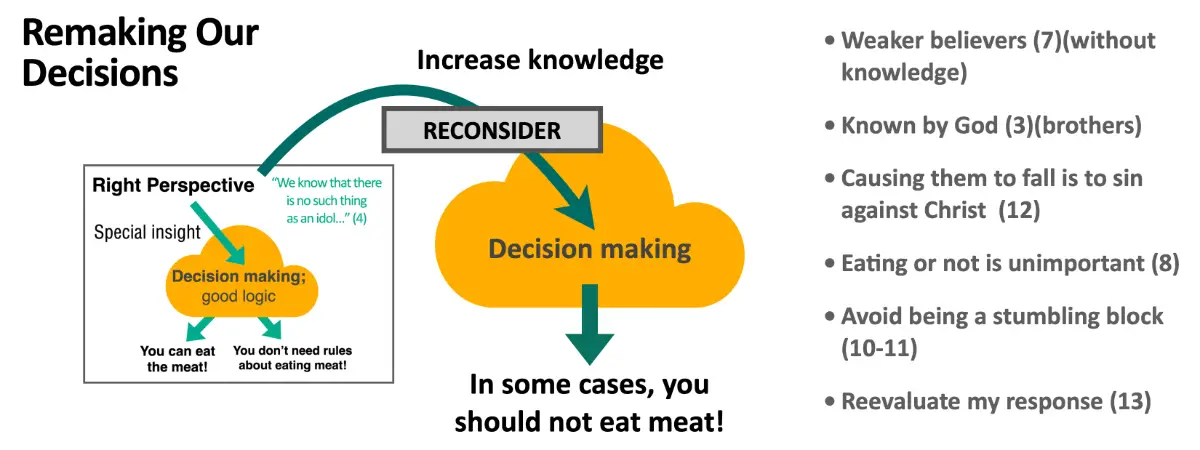
When we use our knowledge but discover it is causing difficulty in our relationship with another brother or sister, we ought to step back and reconsider.
In the diagram above, we see that the left box repeats the original perspective that introduced sin into the church. They were correct, but because their focus was solely on the issue of knowledge of truth, they became blind to another truth—love. With additional input, as shown on the right, Paul helped them understand that there is a better way for the first group to respond to the weaker group. “In some cases, you should not eat meat!” They could do this theologically, yet, out of love and sensitivity to believers growing at different rates, they could and should refrain from eating meat offered to idols. They have not compromised their conviction; instead, they demonstrate the love of Christ in their lives.
Love and Grace
Look below at a redrawing of the Love/Grace chart. What changes do you notice?
1 Corinthians 8: How do I think it through?
Humility incorporates love into our thinking. Paul shows how to navigate the extremes of being right while missing God’s love. Did you ever notice that doctrines are a common source of division?
- Our doctrine and theology often need reshaping.
- Love is a truth that must be incorporated into our theology and decision-making.
- Humility enables us to adjust our attitudes to consider the needs of others rightly.
- Without ‘love’ reconsiderations, we will mislead our brethren and offend Christ.
Humility incorporates love into our thinking.
2. Exemplifying Humility (1 Cor 9:1-27)
Chapter 9 Humility includes sacrifices into our lives. It’s encouraging and helpful to reflect on the lives of others who made sacrifices for us or the church.
1) Paul’s Choices (1 Cor 9:19-23)
1 Am I not free? Am I not an apostle? Have I not seen Jesus our Lord? Are you not my work in the Lord? 2 If to others I am not an apostle, at least I am to you; for you are the seal of my apostleship in the Lord. 3 My defense to those who examine me is this: 4 Do we not have a right to eat and drink? 5 Do we not have a right to take along a believing wife, even as the rest of the apostles and the brothers of the Lord and Cephas? 6 Or do only Barnabas and I not have a right to refrain from working? 7 Who at any time serves as a soldier at his own expense? Who plants a vineyard and does not eat the fruit of it? Or who tends a flock and does not use the milk of the flock?
- Paul bears misunderstandings. (9:1-3)
- Paul fasted. (9:4)
- Paul didn’t take a wife on his journeys. (9:5)
- Paul didn’t take wages from the Corinthians. (9:6-14)
Have you ever struggled to make sacrifices for others?
2) Paul’s Attitude (1 Cor 9:19-23)
19 For though I am free from all men, I have made myself a slave to all, so that I may win more. 20 To the Jews I became as a Jew, so that I might win Jews; to those who are under the Law, as under the Law though not being myself under the Law, so that I might win those who are under the Law; 21 to those who are without law, as without law, though not being without the law of God but under the law of Christ, so that I might win those who are without law. 22 To the weak I became weak, that I might win the weak; I have become all things to all men, so that I may by all means save some. 23 I do all things for the sake of the gospel, so that I may become a fellow partaker of it.
Paul was free, and yet made “a slave to all.”
- To those with the Law (Jew)
- To those without the Law (Gentiles)
- To the weak
Paul evaluates each situation to ensure his personal choices reflect the love of Christ to “win more!” “Evangelism with integrity, relationships with adaptability, and personal holiness with single-mindedness.” (David Prior, p. 159) Where lies your opportunity?
Summary
It’s encouraging and helpful to reflect on the lives of others who made sacrifices for us or the church. Have you ever struggled to make sacrifices for others?
Humility includes sacrifices in our lives.
3. Demonstrating Humility (1 Cor 10:1-33)
Have you ever felt alone loving others?
- Be careful of the temptation to serve oneself. (10:1-13)
- Stop joining feasts with idols. (10:14-22)
- Make adjustments in your lives to edify others. (10:23-30)
Ultimately, we need to apply these truths to our specific situations. Idolatry still poses a threat to each of us, tempting us to prioritize our own needs over the needs of others. Paul reminds us of our duty to prioritize the welfare of both unbelievers and believers over our own desires, so we won't be found wanting when Christ returns.
Humility involves considering people’s needs in our decisions.
The Pinnacle (1 Cor 10:31-33)
“31 Whether, then, you eat or drink or whatever you do, do all to the glory of God. 32 Give no offense either to Jews or to Greeks or to the church of God; 33 just as I also please all men in all things, not seeking my own profit but the profit of the many, so that they may be saved.” (10:31-33)
Humility guides us to bring glory to Him through all our life choices. We aim not to hinder others from God's grace, “just as I also please all men in all things, not seeking my own profit but the profit of the many, so that they may be saved” (1 Cor 10:33).
Your opportunity to serve others exists in every part of your life. Reflect on your life to see if you hurt others (church, family, work, etc.). Don’t resent the duty to make sacrifices for others, but remember how you honor God through your life.
- Humility brings love into our thinking (1 Cor 8:1-13). Paul shows how to avoid the extremes of being right without missing God’s love. His teaching guides us to live graciously with believers who have different understandings, some of which may be less accurate. Love can and must unite us. God’s love in Christ demonstrates that truth and grace go hand in hand, encouraging us to follow Christ’s example. Is there a part of your life where you need to show love? Have you noticed that doctrines often cause division?
- Humility involves sacrifices in our lives (1 Cor 9:1-27). It is encouraging and helpful to reflect on the lives of others who made sacrifices for us or the church. Paul shows his dedication to prioritizing the salvation and edification of others over his own preferences, desires, privileges, and rights. What aspect is the most difficult to give up for better relationships? Have you ever felt like you were the only one struggling with making sacrifices for others?
- Humility involves considering others' needs in our decisions (1 Cor 10:1-33). Ultimately, we must apply these truths to our own lives. Paul reminds us that we are responsible for prioritizing the well-being of both unbelievers and believers above our own desires, so we won’t be lacking when Christ returns. Do you need to reexamine a fixed attitude? Have you ever thought you were alone in struggling with making sacrifices for others?
“Be imitators of me, just as I also am of Christ” (1 Cor 11:1).
Study Questions on 1 Corinthians 8–10
1. What issue does Paul address in 1 Corinthians 8 regarding food sacrificed to idols, and why was it important to the Corinthian believers?
2. In 1 Corinthians 8:1–3, what contrast does Paul make between knowledge and love? How does this inform our interactions with others?
3. How does Paul describe the impact of exercising Christian freedom on weaker believers in 1 Corinthians 8:7–13?
4. What does it mean to 'sin against Christ' by wounding a weak conscience, according to 1 Corinthians 8:12?
5. Why is Paul willing to never eat meat again in 1 Corinthians 8:13? What principle is he illustrating?
6. What might be modern equivalents of food sacrificed to idols where believers need to consider others’ consciences?
7. How can we apply the teaching of 1 Corinthians 8 to disagreements about spiritual practices or lifestyle choices today?
8. In 1 Corinthians 9, how does Paul’s refusal to claim his rights as an apostle demonstrate humility and love?
9. What lessons can we learn from Paul’s example in 1 Corinthians 10 about self-discipline and avoiding spiritual overconfidence?
10. What does Paul mean when he says, 'Everything is permissible, but not everything is beneficial' (1 Cor 10:23)?
11. How can a believer know when to lay down a right for the sake of another’s conscience?
12. How do these chapters challenge our understanding of humility in leadership and ministry?
13. How do the themes of humility and love throughout chapters 8–10 apply to resolving conflicts in your church or community?
Other Related Articles by Paul J. Bucknell on Humility
Humility enables us to find correction before the Day of Judgment. Although we might lose face, position, and wealth, we are far better off than the humble ...
This is an introduction to the study on humility from a biblical perspective.
We are humbled at how the One who should be served, stepped down, put on a Servant's outfit, and served the ones not deserving service. The protocol was clear.
21 Practical Steps in Seeking Humility and Countering Pride · 1 ) Purposely seek humility. · 2 ) Confess your sins to God and others quickly. · 3 ) Keep a …
1 Corinthians 3:10-15 Facing the Fiery Tests with Study Questions ...
Paul is providing a deeper look into the way God works with believers so that the believers will take His Word more seriously and stop playing petty sin games ...
1 Corinthians 12:7 One Body, Many Members | Biblical Foundations ...
1 Corinthians 12:7 gives us special insight into what has been called body life. However, many churches seem to have no clue about 1 Corinthians 12's truths.
Deliver Up to Satan (1 Corinthians 5:1-5) | Biblical Foundations for ...
The Question of Delivering One to Satan. In 1 Corinthians 5:1-5 Paul was lambasting the church at Corinth for condoning uncouth and uncultured ...
1 Corinthians 9:27 The Disqualification of Christians with Questions ...
This question about disqualification offers key insights into a Christian's life purpose on earth. Paul acknowledges that believers will be judged.